Therapist Dismissive of Calling Infidelity ‘Abuse’
Reconciliation therapist Dr. Kathy Nickerson, who’s been thirsty for a Chump Lady smackdown, dismisses the idea that infidelity is abuse. In a video that I’m now giving eyeballs to, she says we should never “label” or “shame” cheaters.
Over the last year, many people in Chump Nation have sent me videos of Dr. Kathy Nickerson and her insipid infidelity advice. In her best tradwife Romper Room voice she performs the Reconciliation Industrial Complex’s greatest hits.
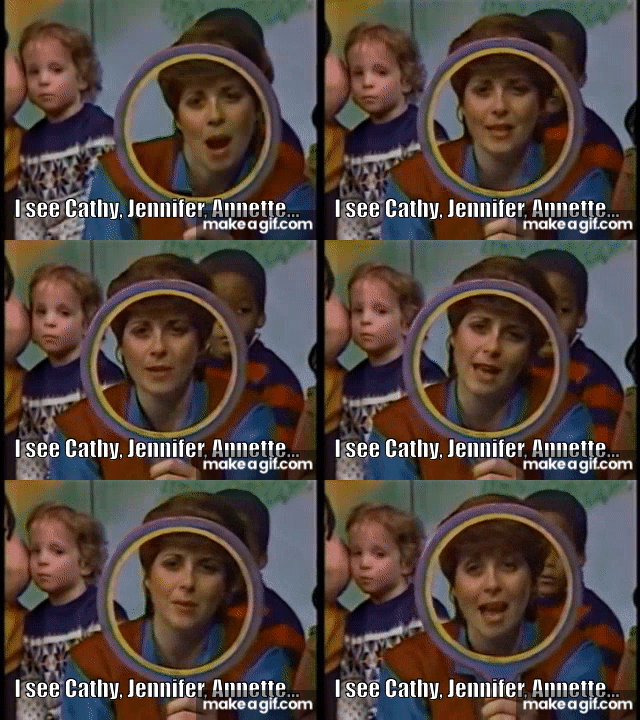
Cheating is “complicated.” We mustn’t judge. Mustn’t shame. And gosh darn, your partner’s double life might be the best thing that ever happened to you! You’ll build back better! I see a unicorn…. yada yada… you all know the script. Perhaps you lost a lot of time and money on this kind of “help.”
In this video above Dr. Kathy Nickerson takes on certain unspoken opponents who have the Unhelpful Idea that infidelity is abuse.
Here’s the transcript.
Is cheating abuse?
So why wouldn’t we question people who stay with their abusers? Okay, let’s talk about this. When you say cheating is abuse, that removes all of the nuance and the details of the conversation. Not all infidelity is the same, right? A one night stand is very different from somebody who struggles with a smex addiction.
I also think that labeling people like that judges them and isn’t very helpful. You know, if you say somebody is an abuser, Does this make them always an abuser? Is there the capacity for growth and learning and change? And if not, why not? And also, if you say that the abusee, the person who was abused, is a victim, well, I don’t like that label either, right? I experienced infidelity.
I don’t wanna be known as a victim. I don’t even really wanna be known as a survivor of that. I wanna say that I am a person who recognized that that behavior had nothing to do with me and I don’t identify as being a victim of abuse. So for the most part I think labeling things this way is just shaming people and is judging people and is not really helpful at all. It’s supposed to be empowering I guess but putting a stamp on something like this really isn’t helpful because the truth is Deciding to stay or not once you’ve discovered an affair is incredibly complicated. You know, you might love this person.
You may have kids with this person. You may have a very long, complicated life with them and not want to leave. You may be older and near retirement and thinking, I don’t want to start my life over. you might be thinking a wide variety of things and whatever you’re thinking it is your life and your choice and your decision and I don’t think somebody else should just come in, tell you it’s abuse and tell you that you’re an idiot or a fool for deciding to stay. So I would rather you not say this to people because it doesn’t help them in any way.
And it doesn’t help the person who cheated do better. So there’s not a lot of value to saying this in my mind. I hope you’ll consider doing something else.
All that waffle and she never actually addresses the main question. Okay, Dr. Kathy, if it’s NOT abuse — why isn’t it? Explain it to me like I’m in kindergarten, sitting on your big braided rug, eating graham crackers.
Curiously, her own website has lots of articles on betrayal PTSD and healing journeys and triggers and all the rest. Which begs the question:
How do you get PTSD from NON-ABUSE?
Did chumps make up the trauma? WTF?
That would be an interesting conversation. Instead, Dr. Kathy Nickerson gives us a bunch of straw man arguments and fallacies, that I’m going to dismantle. And your Friday Challenge is to tell Dr. K what you think of her video.
1. Straw man: “If you call cheating abuse, you’re calling the betrayed person a victim.”
Cheating is abuse → therefore the betrayed person is a “victim” → being called a victim is disempowering → therefore we shouldn’t call cheating abuse.
These things don’t logically follow.
You can describe a behavior as abusive without prescribing an identity to the person who experienced it. “I was subjected to abusive behavior” is not the same as “I am a victim and that is my identity.”
But victim shaming is a common way to shut people down who call out abusive behavior.
Just because you don’t self-identify as a “victim”, doesn’t answer the question whether the conduct meets a reasonable definition of abuse.
Dr. Kathy has substituted “Is this true?” with “Do people find this framing helpful?”
Those are different questions. Clearly, for her own reasons (my guess is the RIC model of send me money and I’ll affair proof your marriage) she thinks the abuse frame is “unhelpful.”
2. Appeal to personal experience / anecdotal reasoning
She says:
“I experienced infidelity. I don’t wanna be known as a victim. I don’t even really wanna be known as a survivor…”
Bully for you. That’s your preferred identity. But it isn’t evidence that infidelity isn’t abuse.
Your personal experience establishes:
I don’t find this terminology useful for myself.
It doesn’t establish:
Therefore infidelity shouldn’t be conceptualized as abuse.
That’s an anecdotal fallacy when her personal preference is being used to settle a general proposition.
Here’s a funny little mind*ck. She says, “whatever you’re thinking, it is your life and your choice and your decision,” while simultaneously using her preferred way of thinking about infidelity to argue against someone else’s conceptualization. Clearly, Dr. K is NOT okay with your choice and your decision to label your experience as abuse, decide it’s unacceptable, and leave.
3. Red herring: “Leaving is complicated.”
Her response:
People may love their spouse. They may have children. They may be near retirement. They may have a long history together. They may not want to start over.
None of those facts have anything to say about whether or not the relationship is abusive. It’s always difficult to leave.
A person can have:
- children with an abusive person,
- decades invested in an abusive relationship,
- shared property,
- retirement accounts,
- love for an abusive person,
- financial dependence,
- social ties,
- fear of starting over,
and still be experiencing abuse.
The difficulty of leaving does not determine whether something is abusive.
In fact, “Why don’t you leave?” is historically a terrible way of analyzing abusive relationships. It’s one way we shame women in domestic violence situations. The complicated reasons people remain are not evidence that the underlying behavior isn’t abusive.
4. Non sequitur: “It’s complicated” → “therefore it’s not abuse”
Let’s try to follow the unicorn think here:
- Infidelity varies considerably.
- People’s circumstances vary considerably.
- Therefore, calling infidelity abuse is an unhelpful oversimplification.
Lots of things that constitute abuse have enormous variation in severity, frequency, context, and consequences. He only cheats on me on Tuesdays. Wednesday through Monday, he’s terrific.
“Abuse” isn’t necessarily a claim that every instance is identical.
Why doesn’t she address this distinction? She could argue “not all cheating is equally harmful.” I wouldn’t disagree. There’s finding out your fiancee is on dating apps and there’s paternity testing your children after 20 years of marriage. There’s inappropriate sexting and there’s losing a pregnancy to a husband’s wandering dick and STDs.
I agree it’s not all the same. But that’s different from:
“Therefore cheating cannot be abusive.”
Those aren’t equivalent propositions.
5. False dichotomy: either “cheating is abuse” or “all cheating is exactly the same”
The “one-night stand versus seggs addiction” example sets up an implicit binary:
Either every instance of infidelity is identical, or the category “abuse” is invalid.
False. A category can contain behaviors with different severity.
Physical abuse is an obvious analogy: a shove and a prolonged beating aren’t equivalent experiences, but that doesn’t mean “physical abuse” ceases to be a meaningful category.
The better question would be what characteristics make particular conduct abusive, not whether every instance of infidelity is equally destructive.
6. Appeal to complexity / “nuance” as a substitute for an argument
“There’s nuance” sounds sophisticated, (are you freebasing Esther Perel?) but nuance isn’t itself an argument against a behavior being abusive.
We routinely make categorical distinctions while acknowledging nuance.
Someone can have mitigating circumstances and still have committed harmful conduct. Someone can have the capacity for change and still have done something abusive.
“Nuance” needs to tell us which fact changes the classification and why. She never does that.
7. Appeal to consequences: “The label isn’t helpful, therefore don’t use it.”
Why isn’t it helpful? What label do you prefer? A sad sausage who is going to see the error of his ways? Wayward?
She repeatedly argues that calling cheating abuse:
- shames people,
- judges people,
- isn’t empowering,
- doesn’t help the betrayed person,
- doesn’t help the cheater change.
Even if every one of those claims were true,(that calling infidelity abuse shames cheaters) they wouldn’t establish that the classification is false.
That’s an argument from consequences:
“This label has undesirable consequences, therefore the label is wrong.”
But truth and therapeutic usefulness aren’t identical concepts.
You could have a legitimate therapeutic discussion about whether, when, and how a therapist should use the word “abuse.”
That’s a different question from whether the behavior can objectively constitute abuse.
8. Equivocation between “abuse” as a behavior and “abuser” as an identity
She asks:
“If you say somebody is an abuser, does this make them always an abuser? Is there the capacity for growth and learning and change?”
Why should I care if this person is harming me? (Oh shut up Tracy, chumps don’t matter compared to the exquisite potential of a maybe repentant cheater.)
There is a difference between:
“This person engaged in abusive behavior.”
and
“This person has an immutable identity as an abuser.”
She moves from a claim about conduct to a claim about permanent identity and then argues against the latter.
Again, that’s a straw man.
Someone can do something abusive, acknowledge it, change, and never repeat it. That doesn’t retroactively make the conduct non-abusive.
9. Begging the question about what constitutes abuse
Dr. Kathy Nickerson seems to assume that calling infidelity abuse is merely “putting a stamp on something.”
But that’s precisely the point. The question is whether particular features of infidelity can satisfy meaningful definitions of abusive conduct.
Infidelity can involve:
- deliberate deception,
- sustained manipulation,
- coercive control,
- exploitation of a partner’s trust,
- financial deception,
- exposure to sexual health risks without informed consent,
- systematic gaslighting or reality manipulation.
If those behaviors meet a definition of abuse, simply saying “don’t put a stamp on it” doesn’t refute that.
She needs to explain why they don’t constitute abuse.
She doesn’t.
10. Appeal to intent — without actually establishing it
Her framing also seems to presume that “abuse” means something like deliberately intending to abuse someone.
But many discussions of abuse focus on the nature and effects of conduct, not simply whether the perpetrator consciously thought: “I’m an ogre! I’m abusing my partner!”
A person can engage in coercive, deceptive, controlling, or dangerous behavior without thinking of themselves as an abuser.
11. She conflates “victimhood” with helplessness
There’s also a philosophical assumption underneath her argument:
victim = powerless, passive, defined by what happened to you.
That’s not what “victim” means.
A person can accurately identify that they were victimized by someone else’s conduct and simultaneously have extraordinary agency about what they do next.
You don’t cease being the victim of a robbery because you subsequently rebuild your finances.
You don’t cease having been assaulted because you become psychologically resilient.
Likewise, someone can say: “My spouse abused me with his double life, and I chose to leave, and rebuild my life.”
The second half doesn’t negate the first.
12. Staying in a relationship with a cheater doesn’t make it NOT abusive.
For all the flutter about chumps have choices, Dr. K seems to tar people who leave and describe their experience as abuse as bitter bunnies who aren’t being helpful to their own healing.
But the fact that someone chooses to remain in a relationship does not tell us whether their partner’s conduct is abusive.
Relationships can endure. It doesn’t mean they’re healthy.
That’s all the skein untangling I have for Dr. Kathy Nickerson today. Your Friday Challenge is to give me your own review.
TGIF.
Discover more from chump lady
Subscribe to get the latest posts sent to your email.




Nice application of logic calling out the poor reasoning of her objection. If I were still teaching, the post would make a great example to give to the students I used to try to teach how to think critically.
Just adding that “Dr. Kathy” got her PhD from an online for-profit university Capella.
That was going to be my question. PhDs are gruelling. Is it possible to do a PhD online only? I’m old fashioned I know… she doesn’t talk like she has a PhD. She talks like she likes being on YouTube.
Wow
I notice the “About” section of her Web site says where she got her bachelor’s (UC Irvine) but only says she got an MS and PhD, not *where* she got them. That’s extremely weird.
She knows.
I have no particular argument with undergrads getting degrees from those places but a master’s or PhD–not credible.
It shows! We used to call those matchbox schools. I earned a real PhD, at a real university, so she can kiss my “Dr.s” ass.
Me, too.
Thanks for this, Tracy. I was wondering about this, especially as a PhD Clinical Psychologist who graduated from a well-known and respected major university, where I had to attend classes in person, be a TA for undergrads, do a year-long APA-approved internship, produce an original piece of research, write and defend my dissertation in person, and so much more. This was back in the 70s. The world has changed. It was so rigorous then, so hard to get into programs. I am in my 70s now and see all sortsof folks hanging out their shingles. Scares me. I had never heard of her until now.. This is sad, and very concerning to me. I worry people are being hurt, misled, and left untreated. I worry they are being traumatized further. I was married to a lifelong serial cheater (he cheated for decades, so yes, I call him a cheater, just like I call myself a competitive runner, as I have been running competitively for decades) and thankfully, am now past that. I have spoken to countless women caught up in the reconcilliation racket. They have lost so many years and so much money. I urge folks to look at the work of Dr. Ramani Durvasula (PhD from UCLA, not at all online!). Good help is avaialble. Please, folks, take the time to carefully consider the help you are getting, not just what your network may cover. Read this site. Take care of yourself. Be kind to yourself. Cheating is abuse.
She overpaid.
Yes, it was actually mentally “soothing” to read through CL’s logic and critical reasoning as it dismantled and corrected each element of Nickerson’s nonsense. Nickerson will have some soul-searching to do if she ever reads this.
She won’t read it. And if she did, I doubt she’d search her soul.
Not labeling it “abuse” comes with a cost, too. You cannot fix a problem without acknowledging the problem. This lady seems to be engaging in reality denial. Infidelity is abuse. That is a fact…even if it is an uncomfortable fact.
If we actually labeled it “abuse” on a regular basis, fewer people would do it. Domestic violence rates have been dropping in Western countries for decades because we have been publicly naming and shaming it. If we’d stayed in the olden days of, “Sometimes a woman just needs a good slap” because it’s “not useful” to use vocabulary like “wife-beater” and “abuser”, those rates probably wouldn’t have dropped.
Even my ex’s very religious family said, “Boys will be boys,” as if that was an excuse.
No! Men are not “born” to cheat (women aren’t either FWIW).
Not only is infidelity abuse, but people who explain away abuse are abusers also.
Follow the money. This chick is making bank off of other people’s misery
I think Dr. Kathy has a bright potential future in politics or corporate PR. That was a staggering amount of words to avoid the question entirely, and instead spit out your own personal talking points.
Sorry Kathy, but I actually do find the terms “abuse” and “victim” helpful. In my anecdotal expertise, it’s actually been healthy to frame this as an event that happened to me instead of a problem I created myself. My spouse didn’t have an affair because of the way I dressed or because I burned dinner. She did it because she wanted to and didn’t care about the effect it would have on me when she did it. I can both be a victim of abuse and a survivor of abuse.
And yes, my experience was abuse. I was told I was being paranoid and that I was imagining things. I was told that my completely reasonable reactions were the real problem. I was pushed to therapy to get over these supposed issues of paranoia and poor communication. If this emotional manipulation was done in service of anything else, nobody would have a problem calling it abuse. So why is it different when it’s done in service of infidelity?
I also don’t see why the difficulty in leaving a cheater would have any impact on it being abuse. Yes, it’s indeed very difficult for me to leave my spouse, for several reasons, including one she listed. But that doesn’t change that she abused me. If I chose to stay, then I would be choosing to stay with someone who abused me. You can put lipstick on a pig, but that would be the choice at the end of the day.
But hey, that’s just my personal experience. Which is either completely inconsequential when I say it, but a universal truth if you say it.
I prefer the term “Thriver.”
“You know, you might love this person.”
How idiotic. We all loved our spouses, and it’s not a reason to stay. In a marriage, love should be reciprocal. Infidelity is the most profound way to demonstrate a complete absence of love for the betrayed spouse.
Excellent comment.
I kinda still love my FW, but I do it from afar so that he can no longer abuse me. Oops, I guess I’m judging him, sorry everyone – what could I be thinking? 🙂
Oh yeah, I recognize this person. I had to mark her videos as “do not show me this content” because the way she talks to chumps so infuriates me.
People regularly comment on her videos to say things like “being cheated on was the most traumatic thing that ever happened to me” and she’ll respond to say things like, “aww, I’m sorry you feel that way! 🙂 Your feelings are valid! <3" and then go right back to explaining why they are wrong for feeling that way. I do not appreciate it.
She also hides comments from people who mention divorce, which is gross. If your feelings are valid then your choice to divorce your cheating spouse is also valid.
You have to wonder what goes on in the mind of someone who is cheated on and then makes it her life's mission to defend her cheating spouse to every chump on Tiktok.
Reason: unhealthy, ineffective coping? Regardless, her comments further hurt chumps. Sounds like she is making stuff up as she goes along.
I’d say she talks like a teenager, but that’s insulting to teenagers.
Haha. She reminds me of the twentysomething tenderqueers I once knew who could use progressive therapy speak to say the most messed up stuff you can imagine
I also agree that there are many examples of abusive behavior that does not rise to the level of “leave this person now.”
Some people feel that shouting at your partner is abusive. Ideally, you should be able to confront your partner with this concern and they should be willing to hold themselves accountable and stop doing it. If this happens and you don’t want to identify as a survivor, great. Some people grow up in cultures where shouting is normal. Sometimes people have bad days. But shouting at your partner is still abusive behavior if it frightens and intimidates them.
The analogy here with cheating is that it is possible to non abusively sleep around outside a committed relationship, if you’re completely upfront about what you are doing and everyone involved says it’s okay. That would be an open relationship, though. That’s a different thing.
The mindf* is that this content creator has videos excusing lack of honesty, accountability, and willingness to change on the cheater’s part.
If you tell your partner that shouting frightens you and they shift the blame, manipulate, and lie, that’s abusive!! How is it not abusive?
Maybe a better fit: if there really such a thing as a one night stand (I’m somewhat dubious) AND the cheater IMMEDIATELY and voluntarily confesses and takes steps to make sure it never happens again, I would say that is not abuse. It’s clearly at best a sign of poor judgement and more likely overall lack of character. Is it enough to divorce? That’s a personal boundary. But without the “secret sexual basement” of lying, gaslighting, theft of marital funds, I wouldn’t call it abuse.
Now, does that scenario ever actually happen? Maybe a handful of times, but it seems like the overwhelming majority of “one night stands” are really just iceberg tips hiding much more.
The secret sexual basement is definitely abusive. The urge to make excuses for taking away a spouse or partner’s agency baffles me. The whole point of marriage or other personal commitments (including business partnerships) is to be be honest and live up to the agreements and covenants that both parties made.
Yeah it’s not a perfect analogy because there’s a blanket assumption in most relationships that sleeping around outside the relationship is against the rules. It’s hard to cheat on someone accidentally.
I guess what I’m noticing is that she excuses cheating by talking about it like you might talk about an open relationship, but without any of the honesty or accountability required to make those relationships work.
All this ho-humming and treating cheaters with a gentle hand nauseates me. You want them to change? Get better? Call it what it it is. Abuse. Make them confront real consequences of the abuse by severing the relationship. They can go out there and “change” and “grow” for someone else.
THIS!!!
As a practising member of the Reconciliation Industrial Complex, Dr Kathy has a vested financial interest in refusing to accept the notion that cheating is abuse ….. a Chump who realises that their Cheater’s actions towards them constitute abuse is much less likely to be willing to pay her for her services so as to reconcile with their Cheater. Her whole business model would be blown out of the water were she to admit otherwise.
She is also full of sh*t, but that’s just my humble opinion.
LFTT
😆🙌
(…was that a Stuart Saves His Family reference?)
I would like to open my screed today with: I have yet to see someone practicing in my field that is a “content creator” that I don’t want to yell at. They’re all just so…bloody dogmatic. And they are trying to sell you something…usually a book or a paywalled blog. Kids these days. Anyhow.
And the AI description of Dr. Nickerson here all seems to be scraped from her website and website ONLY. Marketing. Pure and simple.
I kind of see the point in not asserting the label of “victim” om the betrayed. Kind of. Victim has a stigma. But wait! So does “abuser”! Egads! If you just read her book…
A+B Must Equal C Fallacy. Just. Drips here.
There is an empowering aspect of trauma therapy, in my experience(and yes, this includes my own) of learning to cast off “victim.” My traitor victimized me. Through healing and taking control back, I am no longer her victim. Empowerment is a hell of a thing. In my personal lived experience as a therapist/healer/what have you, part of the journey is “admitting the problem”(Step 1 in step work for those more familiar with that), then resuming control over the issue. Around these parts, that starts with “accepting this is not your fault” and “no contact.”
Unfortunately for someone that has an admittedly difficult to obtain PhD, as our fearless leader illustrated above-there is A LOT of very flimsy logic Dr. Nickerson seems to be selling people.
It’s almost like she has a vested interest in telling people that what she is selling is the way to go. All to a generation of people that seem to be more likely than ever to have…fluid boundaries in their romantic relationships.
I am not seeing anything in the presented narrative about “managing dishonesty and lack of safety.” Or disrespect. Just that it’s “nuanced.” Yes, those are factually nuances. The same way as my expressing the thought of “maybe this person is against the label of “victim” because what she is selling people comes off as victim blaming and that gets you cancelled and reduces your views” is an opinion. Factually correct at a very basic level, yes. But wait! It’s nuanced.
I repeat: I get very, very leery of anybody in my field that is doing the influencer thing in my field. Always seem to have something to sell…and more often than not, the ones that cross my viewfinder tend to cater to very specific demographics that wish to maintain the status quo. It’s almost as if problematic behavior goes away if we all agree that it isn’t a problem. It’s not that it’s wrong-it’s that people make you feel bad for it.
Have a Traitor Free Friday!
According to my abilities in logic Dr. K must be a cheater herself. So much meandering to justifiy that abuse is not abuse. She should sell snake oil. I pity her patients.
Yep a great snake oil salesman she is!
I bet this entrepreneurial “therapist” would become very clear about calling conspiratoral behavior “abuse” if her personal investments were manipulated or stolen.
I have seen her stuff on FB and find it and her nauseating! I commented a couple times that she is delusional – never get a reply. Infidelity is abuse in every sense, end of story!
Yes. Have you ever tried to imagine yourself doing it? My brain buckles at the idea. I can’t even think it through.
Oh, the Gray Rocker in me dreads the fact that this will give her further fodder — I envision at least 12 new IG videos, one for each point that CL makes. More clicks, more views, more $$.
But it feels oh so GOOD. Thanks Tracy for once again taking the bullet for us.
BTW: Another clip that Dr. K put out recently there throws some love to Esther Perel: “A line I love from EP is: ‘Cheaters cheat not to be with someone else, but to become different versions of themselves.’ And I absolutely love that . . .”
I do love that mine succeeded in becoming a different version of herself — a version that ain’t married to me. Thank G*d.
….and I divorced my cheater so I could become a different version of myself. Hope she loves that too.
Oh that’s a brilliant comeback!
Isn’t there a name for needing to become a different version of yourself all the time? Like, in the DSM-V?
Multiple Personality Disorder? Different people all inside the same person. I absolutely love that… what with all the disassociation.
She absolutely LOVES that? Sociopathic chameleons? Couldn’t they just wear different hats? Go to Renaissance fairs? If they don’t cheat to BE with someone else, why involve someone else and their orifices?
Love this! “How do you get PTSD from NON-ABUSE?”
I’m doing a psychology course right now, and I had to write about the Gottman Institute. Curious, I started watching John and Julie Gottman’s post-betrayal video on how to “atone, attune and attach.”
After a few minutes, Julie Gottman starts talking about the post-traumatic stress disorder experienced by the betrayed spouse. I thought, how absurd, she’s acknowledging that cheating causes PTSD, but at the same time advising that reconciliation is still possible.
On the class discussion board, we were talking about the “four horsemen of the apocalypse,” which are “communication styles” that, according to the Gottman Institute, predict divorce: criticism, contempt, defensiveness, and stonewalling.
Fancy that: contempt is a “communication style”. It’s yet another minimization of a very serious problem.
Tracey you should have been a lawyer. Brilliant logic
Hey Cathy! I am going to spell your name with a C instead of a K because K makes me think of klootzak, and I don’t like him so I don’t want to use names that start with K. Anywho… per you, calling abuse what it is:
shames people,
judges people,
isn’t empowering,
doesn’t help the betrayed person,
doesn’t help the cheater change.
You know what else does that? You and members of the RIC like you. I spent well more than 20 years being told not to trust my eyes, my instincts, and what I knew to be true. The refusal of you and anyone in your community to apply the correct word for what I suffered and other chumps have suffered protects abusers. It minimizes our experience. It gives abusers a free pass. There are degrees of abuse. Look in the law; it’s a real thing! Just as there is first degree murder, second degree murder, etc. We don’t refrain from using the word murder because we don’t want murderers to feel bad. Same for any other abuse. Why do you think cheaters should not be accurately called out for what they are doing? If you are uncomfortable with the reality because of how YOU feel about that word, you should probably go into a different career where you don’t further victims’ harm.
I spent most of the first part of that expecting that loud plane in the background to crash and burn. Which seemed about right.
End of the day, I have one main question: why in the Nine Circles should we not judge someone when they cheat?
We judge people for unethical actions all the time.
I am not a particularly religious person, but I really do think we’re supposed to judge cheaters: not coveting thy neighbor’s wife is such an important ancient wisdom, that a large portion of humanity believes it was literally carved in stone and delivered by God. (Also she’s offering not a single shred of evidence to back up a single thing she’s saying. That’s a classic sign of an unreliable source.)
Two of the Ten Commandments are about infidelity: One for doing it and a second for even thinking about doing it!
There’s a lot to unpack here- the good ‘Dr’ could benefit from a good analysis herself going by her word salad of ‘I think’ drivel she has convinced herself is good advice.
They are the words of someone who loves the smell of their own farts but was clearly in the kitchen making coffee or distracted by Oprah when the crucial modules of how to become a half way decent therapist were being shown on her online course.
Perhaps her actual course materials were mixed up and she instead received ‘How to Make up Your Own Facts in 10 Easy Lessons’ and ‘Therapy-The Nil Common Sense Method ‘ with a bonus copy of ‘ BS your way to a Doctorate- Amaze your friends’
Or maybe the certification came free in her box of conscience raising muesli.
Stellar column today CL.
I rarely comment anymore, but this one blew me away. You should have been a lawyer, Tracy.
Soooo many possible things to say. Nice job CL on the point-by-point teardown. As I was reading it, it really just leapt out that this is exactly the kind of rhetoric people applied to domestic violence not so long ago. I highly encourage “Dr.” RIC to go to a battered women’s shelter and explain that they are not victims of abuse because they found it hard to leave their spouse. I also just love how everyone always wants to bring up the “one night stand”. I think most of us agree that there is a big difference. But it seems like the “one night stand” is just as much a unicorn as the entitled cheater voluntarily changing their character.
My biggest gripe here: To me, recognizing that I was a victim is empowering. Victims are acted upon by some outside force or person. By definition, a victim is not complicit, not an actor in what happened to them. Of course this flies in the face of the RIC, which always wants us to examine our part in why they
abused us“sought joy” outside the relationship. Of course I could have been a better partner. But that is a separate conversation than the perpetrators of abuse owning up to their actions, making reparations, and recognizing that they are not owed forgiveness. “Victim” acknowledges the reality of the situation, the wholly one-sided nature of the assault. “Victim” finally let me realize that it wasn’t my fault, that I deserved better. When I finally found a therapist who specializes in betrayal trauma, she spent most of the entire first session repeating in various ways “you have been the victim of a systematic betrayal, made all the more traumatic because it was done by someone who was supposed to always be on your side.” I’m still a long long way from Tuesday, but I couldn’t even start to recover until I internalized that message.At the end of the day I don’t care all that much about the “abuse” label. I firmly believe it is, but since we all have to pick our battles, I claim “victim” is the much more important term. If it truly became normalized, accepted fact, maybe RIC therapists will finally stop telling us how, really, we did this to ourselves.
I agree, nicely said, it is part of understanding The Situation, and I found it empowering. I knew my world had shattered, the rubble was all around. Then when I saw that this was something that had happened *to me* and then therefore that *I had agency*, I was able to have input into The Situation.
In her TED talk on Resilient Grieving, Dr Lucy Hone mentions trauma from various causes, including being “the victim of infidelity”.
My ex had over 50 one-night stands that I know of during our time together. I don’t think it is really beneficial to nitpick this stuff. Our pain is pain regardless. I don’t like the pain olympics because it pits us against each other when we really need support.
While you can argue a one-night stand is different, I’d counter-argue that it’s only different if it’s something that prompts the cheater to be mortified by what they’ve done, and to be entirely forthcoming about what happened, how sorry they are, and how they’re going to fix it and win back your trust. Even then, I think most of us who’ve been chumped would be disinclined to believe any such dog-and-pony show was real, or that one night didn’t really indicate a lot more than one lapse in judgment.
What worries me a lot is the effort by the RIC and Esther Perel and others to lower the bar so that a one-time transgression is normalized, like hey, these things happen. Because no, they don’t “happen.” People do these things.
I agree. Once I got that I was a victim, everything began to get better for me. I stopped justifying my then-husband’s bad behavior and began focusing on my future and what I needed to do to heal.
I was very active in my decision not to reconcile and was on board with the idea that the marriage had to end. It really didn’t matter who filed (my ex filed); I was over it. I was very active with my legal team and pushed to get it done; then I signed all the legal documents saying that my marriage was over-over-over. I agreed!
Years later, I live as a survivor now.
Same.. Elsie I always relate to your story and your comments.
I’m a SANE. Which means “sexual assault nurse examiner.” I perform sexual assault kits on victims when they come to the hospital. And I went to a real, grown up person school to get both my nursing degree and my SANE certification.
Here’s something “Dr.” Kathy should know:
The term “victim,” as it applies to SA, is actually a legally defined term. Whether or not the person identifies themselves that way is up to them (in their own lives, they are free to identify as victim, survivor, etc) but in terms of receiving justice? The word “victim” legally entitles them to services and aid. I.E. the crime victim’s compensation fund which is financial help for victims of crime who have lost housing, income, jobs, etc because of circumstances related directly to the crime committed against them.
This also applies in court cases where there needs to be established a harmed party.
Not every law in every state is the same, but there are circumstances in which the word “victim” does, very specifically, need to be applied.
What a tremendous service you’re doing in life. I am glad that the victims have a compassionate, good-hearted person like you to help them.
I listened to one of her face book quickies. Awful stuff.
I went back to searching for talking puppies.
This is the best take down I’ve read so far in the comments!!!
I try to curate my social media too: cute animals and art history.
Yes, the logic errors in this are appalling. Among other things, I teach middle school logic at a private school, so I recognized all the errors as soon as I read the therapist’s narrative.
I get that some people choose to stay for a variety of reasons, but we can ALSO choose NOT to stay. Using her words, “Don’t judge!” For me, it was ultimately the lie upon lie that made me pull the plug. My therapist (PhD, NYU) had been telling me for several years, “This is NOT salvageable!” No, it wasn’t, and the twisted path that the divorce and closeout took confirmed that. I hit meh after the judge signed off because I was truly over my ex by then. He confirmed just how little I meant to him.
Curious, I looked at Dr. Kathy’s website. She only does coaching, supposedly because it makes her more accessible and gives her more freedom. Ugh, that also means like no oversight or ongoing professional development.
For a time, I did insurance billing for my therapist on the side, and I saw how many requirements there were for her to maintain that link. I also helped her gather the documentation for relicensure. It was a lot, but she was a licensed, clinical therapist, not a fly-by. But that taught me why you have to carefully consider who you are getting your advice from.
So, she doesn’t maintain a therapist’s license. Interesting, but not surprising.
She did say “licensed” on her website, but who knows how current that is.
Some therapists in my area provide their license number and date on their websites, or they have them in their offices. Mine had it framed in her office, and we kept copies in her files and scans for some of the things I did for her.
In my state, that would mean many hours of supervised experience after schooling, followed by ongoing PD and service (lectures, related volunteer work), with paperwork every two years. My therapist kept a written log and documentation related to that in a folder that I organized and put together with a letter.
Don’t get me wrong. I saw a life transitions coach who took me through a set curriculum. That was very helpful, but she limited herself to that and knew her boundaries.
Like the way fleas become hyperactive right before they unalive from your pet’s flea treatment, I think we’re going to see more frantic abuse apologism and minimization from RIC and CSAT mavens in response to the growing body of research supporting a correlation between domestic abuse, coercive control and serial infidelity.
To me, the two most standout bits of bs in Nickerson’s spiel are 1) “If you say somebody is an abuser, does this make them always an abuser? Is there the capacity for growth and learning and change?” and 2) Casting the term “victim” as a dirty identifier.
First off, the term “victim” is nothing more than a neutral identifier for someone who encountered a victimizing force whether it was human-wrought or a natural disaster. It says nothing about who the victim is and everything about the the force that victimized them. Because of this, the classic mark of an abusive mentality is to chase survivors away from the very designation needed for someone to seek justice or compensation by goading them “not to act like victims.” But, in reality, the only people who “act” like victims are abusers. Meanwhile actual victims hate being victims aside from the fact that victims are victims whether you call them banana or late for dinner. It’s just clear language required for compensation and to define a source of danger.
And though Nickerson seems quite sure that the answer to her rhetorical question over whether “once an abuser, always an abuser” is “Uh, well, no, um, I’m not saying people can’t change…”, the statistically-founded answer is “Yeah, once an abuser, probably always an abuser.” This is because, even with therapy, mandated Intimate Partner Abuse Education Programs or even jail time, the recidivism rate among domestic abusers is massive. Furthermore, the late Dr. Evan Stark– one of the few spearheads of the DV shelter movement in the US and UK and spearhead of the movement to criminalize coercive control– warns that increasing legal consequences for domestic batterers does not mean they will stop abusing but merely shift their tactics to coercive control. But as Stark also warns, it’s actually coercive control more than histories of violence that is considered the forensic “golden thread” best predicting eventual lethality.
But if someone wants to cherry pick this, they can always look at the less reliable re-arrest and re-prosecution data on domestic abusers rather than looking to data on victim-witness reports which paint a catastrophic picture of recidivism. And cherry pickers can also rely on the glaring fact that, to date, coercive control is only criminalized in the UK and, in the few places in the world and US states that even include coercive control within legal definitions of domestic violence, the framework is only civil.
But all the same, the only reason the UK criminalized coercive control is because the hard statistical evidence on coercive control best predicts Chris Watts. Or Scott Peterson. Or Fotis Dulos. Or Scott Magnano. Or James Craig. Or many of the coercively controlling cheaters who were never reported for direct violence until the moments they unalived their partners, former partners or children.
Anyway, here are a few citations for anyone not subject to Upton Sinclair’s classic warning about people not understanding things that their salary depends on them not understanding.
Evan Stark — The Dangers of Dangerousness Assessment (2013)
The Core Critique: Traditional domestic violence risk and “dangerousness” assessments are built around an “incident-driven” model. They look for isolated physical attacks, weapon use, or explicit death threats. Stark argues that this approach is dangerously flawed because it completely misunderstands how domestic abuse actually operates.
The Danger of the Checklist: When risk tools focus only on physical severity, they routinely grade chronic, systematic abusers as “low risk” simply because no physical weapon was brandished that day. This creates a false sense of security and ignores the reality that non-violent tactics are often more devastating to a victim’s survival.
Entrapment Over Incidents: Stark emphasizes that the true danger lies in coercive control—a condition of ongoing entrapment characterized by micro-regulation, isolation, economic deprivation, and psychological erosion. A perpetrator doesn’t need to threaten murder to destroy a victim’s autonomy; by stripping away their resources, health liquidity, and safety nets (the exact playbook of financial and emotional containment you experienced), they execute a slow-motion hostage strategy that standard checklists completely fail to register.
Andy Myhill & Katrin Hohl — The “Golden Thread”: Coercive Control and Risk Assessment for Domestic Violence (2016/2019)The Metaphor of the “Golden Thread”: Myhill and Hohl analyzed large-scale police risk assessment data using advanced statistical modeling to determine which risk factors best represent actual domestic abuse. They concluded that coercive control is the “golden thread” running through all domestic violence identification.
Beyond the Incident-by-Incident Response: The study proved that police and legal systems must move away from evaluating isolated physical altercations. Factors most heavily weighted in representing the true construct of dangerous abuse were continuous behaviors: perpetrator threats, controlling behavior, sexual coercion, victim isolation, and victim fear.
The Injury Misconception: Crucially, Myhill and Hohl found that whether a physical injury was sustained during any single, specific incident had no consistent association with the overall dangerousness pattern or subsequent risk. In other words, a lack of a severe physical injury in a single snapshot does not mean the environment isn’t profoundly dangerous. True risk is predicted by the ongoing pattern of control and entrapment, not by whether a single bruise was left behind.
Serial Infidelity and Psychological Abuse: Diagnostic Blind Spots in Recognising Betrayal TraumaRebecca C K Ward
Objective:This narrative review examines the intersection of serial infidelity, coercive control, and psychological abuse as an under-recognised form of betrayal trauma.MethodsGuided by PRISMA principles, a systematic search of four databases (PsycINFO, PubMed, Scopus, and Web of Science) identified 47 peer-reviewed studies published between 1990 and 2025 that met inclusion criteria. Studies were included if they examined repeated infidelity within intimate relationships, associated patterns of coercive control, gaslighting (defined here as psychologically manipulating a person into questioning their own perceptions, memory, or sanity), or the psychological sequelae of sustained relational betrayal. Data were analysed using a narrative synthesis approach to identify convergent theoretical, clinical, and diagnostic themes.ResultsFindings indicate that serial infidelity frequently co-occurs with coercive and gaslighting behaviours, producing psychological effects consistent with trauma responses observed in intimate partner violence. Despite these effects, relational betrayal involving sustained deception and control remains largely absent from psychiatric nosology, contributing to diagnostic blind spots and therapeutic misclassification.ConclusionThis review highlights the distinction between moral judgement of behaviour and the clinical recognition of trauma-based harm. An evidence-informed framework is proposed for identifying betrayal trauma within diagnostic and clinical settings, emphasising trauma-informed assessment and intervention rather than behavioural or personality-based explanations.
Infidelity, jealousy, and wife abuse among Tsimane forager-farmers: Testing evolutionary hypotheses of marital conflict
Steiglitz et al. https://www.ncbi.nlm.nih.gov/pmc/articles/PMC3583221/
It has long been argued that men’s jealousy over women’s infidelity is the strongest impetus to men’s lethal and non-lethal violence against female partners. Less is known about the extent to which women’s jealousy over men’s infidelity precipitates men’s violence against female partners. Husbands are more likely than wives to commit infidelity, and men and women report a similar frequency and intensity of jealous emotions during recalls of potential infidelity. If men are likely to use time and resources for pursuit of extramarital sexual relationships, wives’ jealousy may play a critical role in mate retention, but at potential cost of instigating marital arguments and violence against wives. Given men’s greater size and strength, violence against wives may be used as a “bargaining” tool to strategically leverage a selfish outcome, despite potential costs to the victim, aggressor, and offspring.
This is the first study to document content and prevalence of marital arguments, and prevalence of men’s violence against wives during such arguments in a small-scale society, the Tsimane of Bolivia. We show that men’s diversion of resources from the family is a major source of arguments between spouses and husbands’ violence against their wives. We argue that husbands employ violence to limit wives’ mate retention effort and maintain men’s opportunities to pursue extramarital sexual relationships.
There’s also the fact that abused women show an STD infection rate which is far higher than average. Though a few studies argue that women losing the agency to demand condom use within abusive relationships is the key to elevated infection risk, this takes the focus off how their abusive partners contracted STDs in the first place and also falsely normalizes condom use in committed relationships.
5) Identifying the prevalence and correlates of STDs among women residing in rural domestic violence sheltersGM Wingood
AbstractThe present study uses a cross-sectional study design to assess the prevalence and abuse-related correlates of STDs among women (n = 203) residing in rural and nonurban domestic violence shelters, a venue in which health care providers could intervene by providing STD prevention counseling, diagnosis and treatment. To our knowledge, this is the first study to examine the prevalence and correlates of self-reported STDs among women residing in domestic violence shelters. In this sample, 99% of women reported being physically abused in the prior 2 months, 55% reported being sexually abused and 43% reported being raped. Further, 33% of women reported acquiring an STD during their abusive relationship, 13.3% reported acquiring multiple STDs and 9.2% reported acquiring an STD in the 2 months prior to entering the shelter. In this sample having a history of rape, having an unfaithful partner and fear negotiating condom use were all associated with having an STD history. Coordinating STD services with domestic violence shelters could reach a high-risk population that is not traditionally targeted by STD programs, could increase early detection of STDs, may increase access to and improve the quality of STD-related care, particularly among rural populations, and could be cost-effective.
My mother stayed with my extremely and daily verbally abusive father for 55 years. She was so proud to have that 50th wedding anniversary because she was too sick to ever leave and he stayed to keep abusing us all. But even as a 4 year old, hiding in my room, shivering in fear, I knew it was abuse and wished I could leave. My father was an abuser period. The decision my mom made in staying did not change the fact that 3 little girls grew up listening to him berate her and then one went on to abuse her men, my other sis was left by her husband pregnant and I was cheated on x2 and left both. It does not matter if you have a PHd of any kind, that just makes you a more informed idiot. My therapist was a real PHd and told me I needed to up my physical availability to my demanding husband and how much they need to be handled. She also normalized my then husband’s inappropriate behavior of my daughter. That husband was a serial cheater..Another PHd I saw almost got me killed by talking about Trauma instead of abuse. I confronted each PHD after the fact about their horrific mistakes. A PHd does not mean you know what you are talking about.
Infidelity is abuse, and it is worse abuse than physical abuse because you don’t even know it’s happening to you. If you’re getting pummeled, you can make an informed decision to stay or leave based on what is obviously going on. If you are getting cheated on but don’t know and would leave if you did know…you don’t have all the necessary facts to make a decision!
It is not helpful to the RIC to call cheating abuse. Labeling the cheating behavior “abusive” makes the betrayed more inclined to feel like they shouldn’t stay, making reconciliation more difficult.
Cheating is abusive whether it’s difficult to leave or not.
Cheating is abusive regardless of what you call “the betrayed” or “victim” or “survivor”or “chump”.
So glad I found CL about 3 months after DD1 and didn’t fall prey to the RIC
Yes, and they can’t make any money from you if you leave! It’s all about the revenue stream.
I’m in awe of the Cl’s critique of this nonsense.
I want to apply this Nickerson statement to child s*x abuse: “I also think that labeling people like that judges them and isn’t very helpful. You know, if you say somebody is an abuser, Does this make them always an abuser? Is there the capacity for growth and learning and change? And if not, why not? And also, if you say that the abusee, the person who was abused, is a victim, well, I don’t like that label either, right? “
Based on this argument, Nickerson would argue:
Obviously, there is a difference between a child who is assaulted and an adult who is betrayed by someone leading a double life. At the heart of this comparison is the issue of CONSENT. Children cannot consent legally or morally. Chumps could consent, could say yes or no to opening a relationship. But where child m*lesters and cheaters are alike is they don’t seek consent. They manipulate and groom children. Cheaters lie and gaslight and manipulate to hide their behavior. Both m*lesters and cheaters keep their victims in the dark.
Is she on TikTok and sometimes wears a stupid, floppy hat?
Simple. The therapist has learned her bread & butter lies in shilling out reconciliation. To deem cheating abuse, she would have to admit that she’s advising victims to go back to abusers.
I had a kerfuffle on F.B. with her when I responded to one of her reels. She didn’t like my blunt take on her smug faced opinion that she delivers with such learned assuredness.
I had a friend of Cheaty’s try and chastise me by telling me that he’s gone through much worse than I have. Right. So you’re comparing an experience in your life using only what Cheaty has told you so you know it was worse. Like Ms. Nickerson must be an expert concerning betrayal because she lived it.
Dr. Kathy consciously or unconsciously pursues 3 goals: 1) Justify her business segment in the reconciliation industry, 2) Attract as many customers as possible and keep them as long as possible, 3) Morally justify her personal choice to stay with the cheater.
The last two goals can combine different backgrounds in different proportions, including sincere beliefs and cold calculation.
Unfortunately, her point of view and arguments are too widespread among the victims of cheating, especially during the disclosure of the affair and immediately after D-Day.
All online resources dedicated to infidelity, both objective and aimed at “reconciliation” at any cost, are full of confessions/stories of “fresh” betrayed partners and those who have been choosing a second-rate life under the same roof with a cheater for decades containing a similar message. And the justifications for the choice of these unfortunate people are 100% consistent with Dr. Kathy’s arguments.
Another important question that goes beyond the logic of Dr. Kathy and those who promote “reconciliation”, those who desperately search the Internet and therapists for examples of “successful reconciliation” opportunities and brag about their successes 1, 4, 5, 20, 30 or more years after D-Day.
The question is simple: what is a “successful reconciliation”? Plus a related question: what are its essential practical criteria, even if these criteria inevitably differ in the nuances of each specific situation?
And here 3 psychological categories necessarily come up: trust, forgiveness, and forgetting. All betrayed constantly confuse these concepts, combine them into different combinations for themselves and cannot or do not want to see their objective meaning and significance for them.
At the same time, the vast majority of both betrayed and cheaters focus on “trust”, then on “forgiveness”. The propagandists of “reconciliation” prefer to keep silent about forgetting, although it is precisely this feature of our mind that determines the true “success of reconciliation” (and that makes it fundamentally impossible for us to really accept an affair and AP, to start life with a cheater from scratch, as if nothing had happened).
After the “reconciliation”, the cheater may well no longer have sex with others behind the spouse’s back, the betrayed may “forgive” the cheater after some time – I understand the term “forgive” in the sense of stopping punishing them when communicating or during physical interactions in life under one roof. It’s similar to how society forgives criminals who have served their sentences in jail).
But our memory is our biological curse. We can forget a lot, but neither animals nor humans ever forget severe physical and moral injuries and abuse (which is the subject of our discussion with Dr. Kathy). This is impossible in principle.
Obviously, Dr. Kathy has not forgotten the tragedy of infidelity she has experienced and will never forget, until the grave. Like all of us, victims of cheating.
She chose to stay in a tarnished relationship, suppressing her pride and self-esteem in the name of some obvious material advantages or out of self-doubt, insecurity. I am not a professional psychologist and I cannot say whether pride, self-esteem, integrity are discrete concepts, that is, either they are or they are not. Or, for example, you can be proud selectively and with varying degrees of intensity: a little proud, medium proud, or 100% proud. In my humble, unprofessional opinion, all the components of an individual’s morality that I have mentioned either exist or do not exist.
In other words, staying with a cheater, apart from mundane reasons (advantages, benefits), means a lack of pride, self-esteem and integrity. And this lack of moral backbone affects and will affect betrayed person in any life circumstances and with any people who are not related to the affair they experienced.
I feel sorry for Dr. Kathy as a victim of her partner’s infidelity.
I strongly disagree with her vector of providing psychological assistance to victims of cheating.
I believe that she causes great harm to the victims of infidelity, persuading them to follow a path that leads them to a dead end and condemns them to a life they never wanted for themselves before D-Day.
I also believe that it does a lot of damage to truly repentant cheaters (yes, there are very few of them, but they are there!) and she does not allow them to make the only right decision: to break off relationship with the betrayed for the sake of the betrayed good, unless the betrayed decides to stay because of material, prestigious reasons, because of fear of remaining alone, because of codependency, children, illness, etc.
After D-Day, there is only one objective successful long-term survival strategy for the betrayed partner – to immediately declare the separation of the relationship/marriage and begin practical actions to implement this separation. We may have to co-exist with the cheater in close contact for a long time, but the goal and the only means of true healing is separation and the absence of a constant reminder of betrayal nearby.
The path to understanding one’s own importance, to understanding the inevitability of overestimating the values of both the cheat and the previous life with them is extremely difficult and painful.
We seek help from therapists because we don’t want to call on our own strength and resilience, which Mother Nature has endowed us with. And too often these “experts” turn out to be professionally untenable or just greedy crooks.
Leo,
I totally agree with your breakdown of Nickerson’s culpability in enabling abuse. You make some really great points. But, as a fellow non-clinical non-expert but one who believes that, in an age when laws are often founded in scientific theory (for better or worse– often worse when the science is junk), average voters have to be somewhat literate in science to avoid being disenfranchised, I urge you to subscribe to Dr. Emma Katz’s or Dr. Elizabeth Dalgarno’s Substack platforms on coercive control. I think it’s the one piece of information you may be missing regarding why victims stay. Both of these forensic experts are globally recognized authorities. Both– like their predecessor and spearhead for the movement to criminalize coercive control, Dr. Evan Stark– completely ginsu the old, debunked “codependency” theory of why victims “don’t leave sooner” as statistically invalid, harmfully victim-blaming and grossly underestimates the diabolical lengths that coercive controllers will go to entrap their prey.
The above view in no way contradicts your main point that it’s corrupt and destructive for reconciliation mavens to encourage victims to return to abusers. But the above view adds another level of absolute condemnation of anyone who would coddle and enable a coercively controlling abuser (which a rash of recent groundbreaking research correlate to serial infidelity) because, as Evan Stark and colleagues incontrovertibly proved with statistical research is that it’s coercive control– even without histories of physical assault– that best predict lethal outcomes.
In other words, the data on coercive control– which was incontrovertible enough to criminalize coercive control in the UK– argues that the “wages of sin” for Nickerson’s and her ilk are potentially death (for victims). But what Stark also demonstrated over his half a century of research and advocacy is that this potential for death that immediate victims can “sense” in an intuitive way (Stark argues that these intuitions for survival are “brilliant”) is precisely what keeps many entrapped even while bystanders fail to see the effective barbed wire web entrapping them. Stark and others found that victims do, in fact, leave but typically when the danger of staying finally exceeds the considerable danger of leaving.
Of course many victims also survive their escapes and find that the proverbial gun that they sensed was pointed at their heads and kept them entrapped for too many years was made of licorice and had no bullets. They might feel “stupid” for hesitating. But the fact remains that our internal risk management faculties just don’t like the wager when dealing with an abuser who has found an “off” switch for empathy. It makes them capable of anything… which the grim unaliving statistics related coercive control show. It’s like our communal lizard brains can sense the actual statistics that some victims don’t survive their escapes (because leaving an abuser increases risk of death by 800 fold for up to two years following escape and then only somewhat decreases thereafter).
In any case, what I discovered as a volunteer, non-clinical advocate years ago was that explaining to the vast majority of survivors that their intuitive hesitation to escape was not self-defeating codependency but “brilliant” survival instincts based on the actual risk involved with leaving this type of abuser does not encourage victims to stay put. What that reassurance typically does is helps survivors map the statistically conceivable risks their abusers pose, conceive of specific strategies to neutralize each of those risks and “turn the tables” on abusers and then ultimately start mapping out a viable exit plan.
There is one exception to the healing power of the non-blaming view which is that nowhere is it written that an abusive personality can’t be abused by a bigger abusive personality. So if you try to share the non-victim-blaming view with someone who has their own culpability regarding gratuitous abusive behavior (and not merely “reactive abuse” of actual victims having to fight back against abusers), it will only piss them off. But the vast majority of victims– like any cross section of the public– are not secret abusers and tend to respond very positively to being “disabused” of victim-blaming malarkey.
What happens in the process of survivors shedding the “codependency” nonsense is actually extraordinary because, as they say, the truth really does set people free. Whatever Stockholm syndrome/captor bonding that survivors were under the spell of to survive their abuse (because that “bond” goes two ways and most “captors” may be moved to show amnesty to a seemingly “loyal” victim but will instantly punish the merest whiff of rebellion) will start to fizzle away like piss on a Georgia sidewalk, revealing that victims had not actually “loved” their abusers since the abuse began but were merely playing possum to get through it alive (again because our internal risk management faculties factor risk and hate to gamble).
You sound like someone is interested in science related to advocacy and the above are some ideas and thinkers which I have found very helpful for what it’s worth.
Thanks, Hell of a Chump, for your reply and for the information that is very useful to me.
Your thoughts, knowledge and analogies are much deeper than mine, because, firstly, I am not a professional or even an advanced amateur, but just a ordinary person who has lived in this world for a long time and has seen a lot, and even more so has read about the problem of infidelity in general and about the imperfections of human nature, that is, morality developed under the influence of family, society and all its attributes, including school, university, work, hobbies, literature, cinema, TV, the Internet with social networks, etc.
In adulthood, I intuitively became a follower of the philosophy of existentialism and believe that every adult bears sole and full responsibility for their own actions. We rarely and far from fully control the events around us, the behavior of other people, including in relation towards us. But we and only we are responsible for our reaction to external influences, it is our choice and only our choice how to respond to the good and evil inflicted on us or to react to events that are not directly related to us.
We are responsible for our morality and for the manifestation of the character traits that follow from it. If it concerns people, then I am 100% convinced that we teach everyone (including cheaters) how to treat us. We allow them to neglect us, insult us, lie to us, betray us. We are not supermen/superwomen with the brains of Miss Marple, Sherlock Holmes, Dr. Emma Katz or Dr. Elizabeth Dalgarno and we may not always notice the “red or yellow flags” and analyze them. But when faced with proven betrayal, insult, and violations of oaths and promises that we were given (not only in relation to committed relationships) we simply have to act in accordance with our moral core. Another thing is what is this core really like? Is it the one we imagine or a completely different one that allows for compromises with conscience, justifying our hypocrisy, double standards, cowardice, illusions beneficial to us, allowing insults and indecent behavior towards us under certain conditions?
After all, this is exactly what all betrayed partners on D Day face in real life!
And it doesn’t matter if we call a cheater’s behavior abuse, call them abuser or w&&re (of both genders) or something else. Terminology is not important, only the practical conclusion from the situation and the correct reaction to it are important.
Alas, not all of us can apply our high moral standards that we have proclaimed to ourselves and others. After all, we are always pulled back by ordinary inertia, laziness, unwillingness to change the established order and look for another partner, another life, to lose full access to children, a comfortable home, money, and a routine for. We so want our lives to magically return to that day, after which the shadows of red flags began to move around, which through pink glasses seem to be Green Peace flags. And we give up, we don’t give up right away, but gradually, day after day, we give up our moral positions one by one until we simply don’t have the spiritual and/or physical strength to take the decisive step and break with the person who has been abusing us (or somehow keeps abusing us now).
I am deeply convinced that for a betrayed partner, the best strategy for their own healing which minimizes the consequences of cheating’s abuse and related moral injuries, is to leave the relationship in order to try to build a new life without the presence of a traumatic reminder under a protective roof.
To make such a decision, we do not need to go into terminology or try to brand a cheater as an abuser, we do not need to deeply understand the psychology of the abuser, their victim or the Stockholm syndrome. We need a firm conviction of our innocence in what happened, a firm awareness of our personal purpose and what we should do immediately after the confrontation, the next day, a week later… You see, I’m talking practically from the point of view of a layman who has experienced betrayal himself. This does not mean that in-depth knowledge of the psychology and behavior of criminals is not important. It’s just another level that not everyone can reach.
At the same time, everyone knows the irrefutable time-tested facts. 1) A person will never forget a serious injury inflicted on them and will always be wary of the one who inflicted it. 2) Complete healing is impossible, the wounds will heal, but they will remain until death. 3) There is no guarantee that a betrayed partner will find true happiness in a new relationship or being single, but we can give a 100% guarantee that they will not be truly happy with a cheater and will not even find true peace and self-confidence. These facts are evidenced by the entire experience of mankind.
But, as you and others rightly point out, life is complicated, so in addition to a strategic plan, the betrayed partner is forced to adhere to the right tactics, depending on the circumstances before and after D-Day. And here, too, it should be borne in mind that we are dealing with the liar, the betrayer, the abuser (we can come up with many more nicknames expressing our negative attitude towards the cheater). Technically speaking, it is necessary to optimize the trajectory of our life path from the point of Day D to the moment of realization of the goal (achievement) with constantly changing external conditions, including our material and housing conditions, obligations towards those who depend on us and many other factors.
There are different ways to get a divorce and start moving on. We can get divorced judicially or split up in different ways: we can fake a “reconciliation”, we can open a marriage, we can agree to be roommates, we can arrange a period of coexistence under one roof, we can just behave according to our chosen style of behavior (something like Grey Rock to varying degrees, lack of sex, and so on). But for some reason, all betrayed see only extreme cases – to leave or stay. And this creates huge problems for them, including the problem of one-sided perception of reality and the substitution of goals for tasks and vice versa.
You see, we started discussing whether cheating is abuse or not and what exactly is abuse, but ended up with the practical aspects of the cheating victim’s reaction to infidelity and their further behavior, which will determine whether the betrayed person will continue to live with dignity, without infringing on his moral qualities, or will give up and turn into a moral wreck, striving to justify all their decisions every day until the grave.
I also want to express my humble opinion that the excessive immersion of the victim in psychology and scientific analysis of human behavior not only does not help betrayed from a practical point of view, but even harms them. They will pick up a lot of terms, learn a lot of theories, and a real mess will form in their head, so they will start rushing from one solution to another, and this will only help dishonest cheaters who use the slightest hesitation of their victims as a lever of manipulation.
But unqualified /dishonest psychologists who require victims to pursue a consistent policy of “reconciliation” are also harmful, supporting them with the illusion that everything will be fine, you just need to work hard on the relationship and come to consultations.
So what to do?
I risk being booed on this forum but I think it’s better for the victim not to contact shrinks, at least not MC, but to listen online or in person to the practical advice of those wh
Thanks, Hell of a Chump, for your reply and for the information that is very useful to me.
Your thoughts, knowledge and analogies are much deeper than mine, because, firstly, I am not a professional or even an advanced amateur, but just a ordinary person who has lived in this world for a long time and has seen a lot, and even more so has read about the problem of infidelity in general and about the imperfections of human nature, that is, morality developed under the influence of family, society and all its attributes, including school, university, work, hobbies, literature, cinema, TV, the Internet with social networks, etc.
In adulthood, I intuitively became a follower of the philosophy of existentialism and believe that every adult bears sole and full responsibility for their own actions. We rarely and far from fully control the events around us, the behavior of other people, including in relation towards us. But we and only we are responsible for our reaction to external influences, it is our choice and only our choice how to respond to the good and evil inflicted on us or to react to events that are not directly related to us.
We are responsible for our morality and for the manifestation of the character traits that follow from it. If it concerns people, then I am 100% convinced that we teach everyone (including cheaters) how to treat us. We allow them to neglect us, insult us, lie to us, betray us. We are not supermen/superwomen with the brains of Miss Marple, Sherlock Holmes, Dr. Emma Katz or Dr. Elizabeth Dalgarno and we may not always notice the “red or yellow flags” and analyze them. But when faced with proven betrayal, insult, and violations of oaths and promises that we were given (not only in relation to committed relationships) we simply have to act in accordance with our moral core. Another thing is what is this core really like? Is it the one we imagine or a completely different one that allows for compromises with conscience, justifying our hypocrisy, double standards, cowardice, illusions beneficial to us, allowing insults and indecent behavior towards us under certain conditions?
After all, this is exactly what all betrayed partners on D Day face in real life!
And it doesn’t matter if we call a cheater’s behavior abuse, call them abuser or w&&re (of both genders) or something else. Terminology is not important, only the practical conclusion from the situation and the correct reaction to it are important.
Alas, not all of us can apply our high moral standards that we have proclaimed to ourselves and others. After all, we are always pulled back by ordinary inertia, laziness, unwillingness to change the established order and look for another partner, another life, to lose full access to children, a comfortable home, money, and a routine for. We so want our lives to magically return to that day, after which the shadows of red flags began to move around, which through pink glasses seem to be Green Peace flags. And we give up, we don’t give up right away, but gradually, day after day, we give up our moral positions one by one until we simply don’t have the spiritual and/or physical strength to take the decisive step and break with the person who has been abusing us (or somehow keeps abusing us now).
I am deeply convinced that for a betrayed partner, the best strategy for their own healing which minimizes the consequences of cheating’s abuse and related moral injuries, is to leave the relationship in order to try to build a new life without the presence of a traumatic reminder under a protective roof.
To make such a decision, we do not need to go into terminology or try to brand a cheater as an abuser, we do not need to deeply understand the psychology of the abuser, their victim or the Stockholm syndrome. We need a firm conviction of our innocence in what happened, a firm awareness of our personal purpose and what we should do immediately after the confrontation, the next day, a week later… You see, I’m talking practically from the point of view of a layman who has experienced betrayal himself. This does not mean that in-depth knowledge of the psychology and behavior of criminals is not important. It’s just another level that not everyone can reach.
At the same time, everyone knows the irrefutable time-tested facts. 1) A person will never forget a serious injury inflicted on them and will always be wary of the one who inflicted it. 2) Complete healing is impossible, the wounds will heal, but they will remain until death. 3) There is no guarantee that a betrayed partner will find true happiness in a new relationship or being single, but we can give a 100% guarantee that they will not be truly happy with a cheater and will not even find true peace and self-confidence. These facts are evidenced by the entire experience of mankind.
But, as you and others rightly point out, life is complicated, so in addition to a strategic plan, the betrayed partner is forced to adhere to the right tactics, depending on the circumstances before and after D-Day. And here, too, it should be borne in mind that we are dealing with the liar, the betrayer, the abuser (we can come up with many more nicknames expressing our negative attitude towards the cheater). Technically speaking, it is necessary to optimize the trajectory of our life path from the point of Day D to the moment of realization of the goal (achievement) with constantly changing external conditions, including our material and housing conditions, obligations towards those who depend on us and many other factors.
There are different ways to get a divorce and start moving on. We can get divorced judicially or split up in different ways: we can fake a “reconciliation”, we can open a marriage, we can agree to be roommates, we can arrange a period of coexistence under one roof, we can just behave according to our chosen style of behavior (something like Grey Rock to varying degrees, lack of sex, and so on). But for some reason, all betrayed see only extreme cases – to leave or stay. And this creates huge problems for them, including the problem of one-sided perception of reality and the substitution of goals for tasks and vice versa.
You see, we started discussing whether cheating is abuse or not and what exactly is abuse, but ended up with the practical aspects of the cheating victim’s reaction to infidelity and their further behavior, which will determine whether the betrayed person will continue to live with dignity, without infringing on their moral qualities, or will give up and turn into a moral wreck, striving to justify all their decisions every day until the grave.
I also want to express my humble opinion that the excessive immersion of the victim in psychology and scientific analysis of human behavior not only does not help betrayed from a practical point of view, but even harms them. They will pick up a lot of terms, learn a lot of theories, and a real mess will form in their head, so they will start rushing from one solution to another, and this will only help dishonest cheaters who use the slightest hesitation of their victims as a lever of manipulation.
But unqualified /dishonest psychologists who require victims to pursue a consistent policy of “reconciliation” are also harmful, supporting them with the illusion that everything will be fine, you just need to work hard on the relationship and come to consultations.
So what to do?
I risk being booed on this forum but I think it’s better for the victim not to contact shrinks, at least not MC, but to listen online or in person to the practical advice of those who are really faced with infidelity and the consequences of two options: leave or stay.
My head feels like exploding with incredulity.
Maybe she should take a real college class; I suggest she start with the undergrad, lower division class “Critical Thinking”, where she can learn all about logical fallacies. Nice calling them all out, CL!
And maybe she can read some “for the general public” books. In Van Der Kolk’s book one learns about how trauma is stored in the body and affects you forever (though trauma therapy helps). In Bancroft’s book one learns that abusive men abuse and DARVO women, not because they had a sad childhood, but because they simply can- thanks to partriarchal entitlement. In Minwalla’s white paper we learn that the infidel’s secret actions absolutely have an extreme damaging effect on the faithful partner’s enteric system, gut intuition, innate sense of safety, sense of reality, basically her actual sanity. And then there’s the dozens of recent memoirs of women who have told their stories of what happened to them mentally/ psychologically, emotionally etc, after they discovered their partner’s cheating.
My eX abused me financially, sexually, emotionally, socially (public humiliation), treated me like a literal sex slave, stole money, kept secret financial info of which I had zero knowledge or consent, exposed me to the germs of dozens of prostitutes from all over the country, for years, denied his actions when caught out, lying to my face, accused me of cheating, accused me of making all this up, called me crazy and published to friends and family that I was having a breakdown and “please pray for Viktoria” as if something is wrong with me, implying my mental breakdown. If I’m “crazy” it makes sense that I suddenly left him right? Even after celebrating our 30th anniversary with dozens of friends and family at a large party? The damage as a result of all this to my formerly gentle, sensitive, trusting, sweet, forgiving, saintly, loving, self-sacrificing and good girl self, is immense.
Fucqqqe my eX with a cheese grater; he is an abuser and a user and a predator and a liar and a thief and I will be working on my safety, mental health, sense of reality (enteric/ENS) and healing for many years to come. And fake doctor idiots like this lady won’t be the ones helping me. She would be helping society more if she worked at a grocery store. (No disrespect to grocery store workers, thank you so much for all you do!)
One of the reasons I worked as a volunteer nonclinical advocate for several years while toying with the idea of getting a higher degree in something related to social work and forensics (had kids in the meantime but might still do this when they’re launched) is because, as a former victim of workplace stalking (who prosecuted successfully), I had seen the grave damage that sh*tty helping professionals with only shallow theoretical training but no gritty on-the-ground trench experience could do to survivors, especially those first reaching out for support and still at risk. It is UNFORGIVEABLE.
This arena is where angels should really fear to tread or take a wrong step but so many do based on biased, antiquated junk science of yore. This is why I practically have a shrine to the late Dr. Evan Stark, one of the coiners of the coercive control concept and a major spearhead to criminalize it as well as his wife and co-researcher Anne Flitcraft. They both scientifically trounced and dissected ineffectual and damaging so-called helping professionals and all the crap theories these unhelpful professionals founded their lousy approaches on.
And this is relevant to the issue of “infidelity as abuse” since, as it turns out, many of the leading lights of RIC and the grossly victim-blaming guru who created the CSAT certification (Patrick Carnes) were merely repurposing all the old junk science theories that once falsely cast battered women as generally culpable in their own abuse. It’s no longer fashionable to apply those junk theories to victims of DV and many state Intimate Partner Abuse Education Programs (mandated batterer education programs) ban the application of them because their licenses depend on it. But in comes RIC and CSAT to recycle the junk science and slap it on victims of infidelity/abuse by chiefly refusing– as Nickerson attempts– to correlate serial infidelity to abuse.
Neat trick, huh? Bet they think it’s “sustainable” not to let those old blamey theories go to waste at the theoretical scrap yard.
Yes- I always toyed with the idea of going ‘official’ with my community work and getting a degree etc – but why?
There’s no way I’d be swallowing that BS in class or listening to people endorsing it .
It cuts me out of a lot of work in the degree obsessed world, but I couldn’t endorse that steaming pile.
Black market underground counselling anyone?
Me! Me! Sign me up for black market underground counseling! 🎊
Kathy Nickerson is worthless. My FW and I used her for therapy. Worthless. And her new “research” with the Gottmans shows that over 70% of cheaters say that their marriage was BETTER after the affair, while just 37% of Betrayed felt that way. You should have read how she down played THAT. I resent these therapists that they aren’t HONEST with women: It’s never going to be the same. Oh. She’s been cheated on and apparently it gave her a great career as” infidelity specialist.”
There are two Kathy Nickersons listed as California psychologists. Does either of these match her name and location?
NICKERSON, KATHERINE LOUISEAssociate Marriage & Family Therapist
NICKERSON, KATHLEEN FEE
Oh man did you get under her skin! She’s done a SECOND post about it.
Thank you for the rhetorical TKO here. I watched the video and found it to be an absolute logical nightmare. Then I read the rest of your post and felt validated.