
How to Spot a Psychopath?

Is it possible to spot a psychopath? Or are they just so deceptive you’ll never know? Is anyone looking at the intersection of infidelity and psychopathy?
***
An alert chump sent this recent article from the Guardian: “How to spot a psychopath: It’s like the difference between a domestic cat and a wild cat.”
I don’t think you can spot a psychopath.
Not because I don’t think psychopaths don’t exist, (sadly I do), but because some people are so utterly deceptive, how would you know?
That’s not a very comforting thought, Tracy.
Right? Which is why I tell people to focus on their boundaries and personal resilience instead of trying to preemptively sniff out “Bad People.”
Whoever is in your life, no matter how outwardly nice, or normal they appear, if they want you do something that goes against your values or sense of personal safety, DON’T DO IT.
There. That’s your magic amulet.
I feel like I have to lead with that point, because one favorite criticism of abuse victims is that we’re armchair psychologists “labeling” people. (Big wave to Dr. Kathy!) I do label cheaters — I call them “f*ckwits” because we don’t know what flavor of the DSM they are. We just judge them by their behavior. Which is to say:
You don’t spot a psychopath, you experience them.
You know you’ve tangled with a disordered person when you find your wallet missing, your girlfriend gone, your scout leader indicted. Everything is normal up until the moment it isn’t.
Are you saying all cheaters are psychopaths, Tracy?
No. But I think a lot of personality disordered people display a shocking lack of empathy for their partners and are personally exploitative. I leave the diagnosis and debate to shrinks. I’m here to comfort the afflicted. The poor chumps who tangled with these freaks. And to raise awareness that not everyone is wired the same. We don’t all share the same moral outlook or values. A big shout out to the work of blog friends (who have PhDs from accredited universities! and aren’t life coaches!) Dr. George Simon and Dr. Peter Salerno.
No one is studying across disciplines how these people behave.
This is the part of the article I found fascinating:
It wasn’t from a forensic psychology but a business studies background that Dr Karen Mitchell arrived in the territory of high-functioning psychopathy. By the late 2010s, she’d spent 30 years working as a consultant on large-scale change in corporate culture. Her work tended to be with organisations in crisis: “So it might be market alignment, or deaths or suicides in companies,” she tells me from her home in Australia. Observing the sheer number of problems at work that stemmed from specific individuals with predatory traits, she started to research those same “dark personality” behaviours in other precincts. “Child sex abuse in religion, coercive control in human trafficking and domestic violence and terrorism,” she says. “When you look at all our global knowledge on human predators, there are so many fields and none of them interact.”
Right? So please researchers, come study the chump experience.
This matters because predatory personalities cause an astronomical amount of harm. We’re bad at recognising them interpersonally, for reasons to be discussed, but we’re also bad at pattern finding in aggregate – mainly because different disciplines have so many different names for these kinds of people. Mitchell lists some of the terms: “Malignant narcissist, dark triad, psychopath, coercive controller, primary psychopath, grandiose narcissist, corporate psychopath, Machiavellian, dark tetrad, covert narcissist, toxic leader.” These are all traits that she argues are part of the same phenomenon, the Dark Personality, or the Persistent Predatory Personality.
Here we called them FWs. We’re chumps because we were preyed upon. Deceived. Stolen from. That’s what infidelity is — a conspiracy. I don’t know why more people don’t look at it that way, but if you’ve experienced it, learning about personality disorders makes sense.
- Why are they stepping over your crumpled sobbing body to fix themselves a HotPocket?
- How do they sleep like babies after D-Day?
- Where is their adaptive anxiety?
- Why do they lie so fluidly, so easily?
- How do they turn their “emotions” on and off and cry on cue?
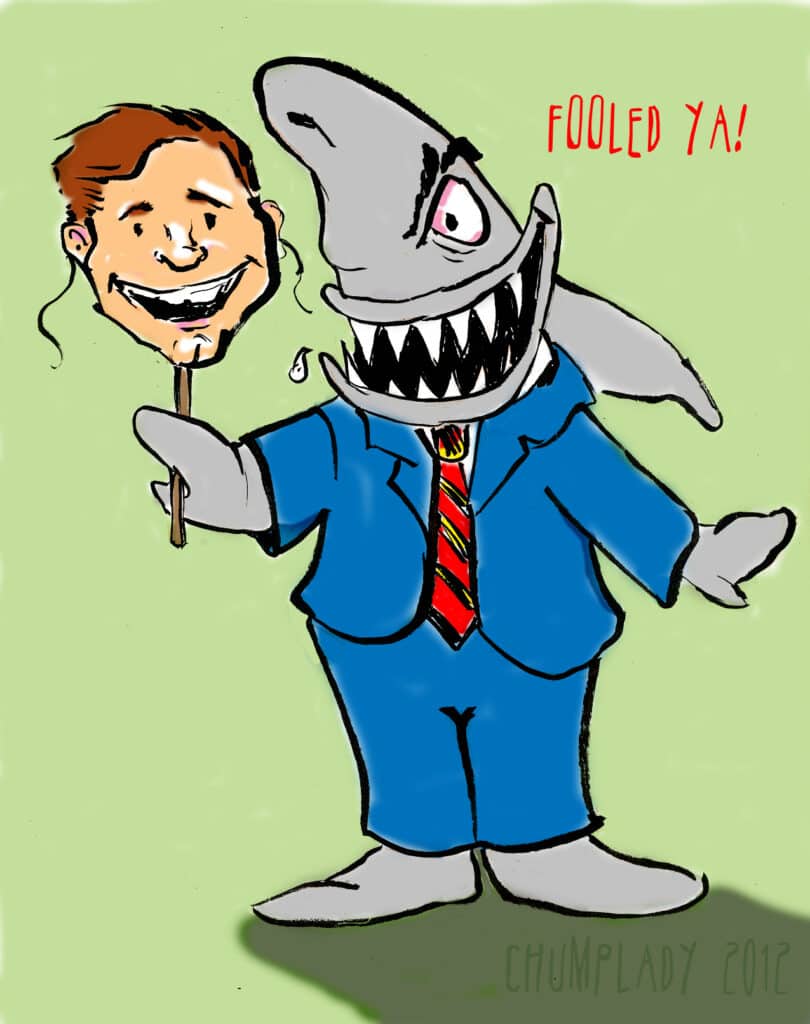
- Why do they look at us with shark eyes?
- Why do they get pleasure from our pain? Why does it give them a contact high of centrality?
- What’s the point of goading us into humiliating competitions they know we’ll never win?
- Why are they so grandiose as to think we want to reconcile with them or they’re a prize worth having?
I could go on and on and do on this blog. Why are our stories ALL SO SIMILAR?
Someone please get a research grant.
Discover more from chump lady
Subscribe to get the latest posts sent to your email.







Lots of siloing and the mentality of you cannot play in my sandbox. Plus, the intellectual arrogance that gets in the way. Lots of poor and unhealthy behaviors get explained away because confrontation is uncomfortable and difficult, and it’s easier to be agreeable or conform around these behaviors. Go along to get along…
Boiled frogs all
Continuing this conversation, how do you recognize a sociopath from a psychopath?
When the judge in my divorce case took me into her chambers with my lawyer and FW’s lawyer and told me “did I know that my FW was a sociopath and one of the worst she had ever seen in her courtroom?”.
That is the lovely person I was married to and have thankfully left in the dust years ago.
FW is definitely grandiose but old so much harder to pull off, emotionless, still shallow, deeply rooted only in his childhood, lying and all around absolutely pathetic. Dead eyes say it all.
Definitely the best loss I’ve ever had
Nature vs nurture plays a part in it, with psychopathy leaning more on genetic factors while sociopathy is heavily shaped by environment and social conditions, but the real difference shows up in how they navigate society. Sociopaths are typically too impulsive and volatile to hide who they are for long, which is why they are far more likely to get caught and wind up in the justice system. Research on secondary psychopathy and sociopathy in prisons links this frequent incarceration to severe emotional instability, a pattern further backed by neurological studies on inmates showing specific deficits in brain regions that handle impulse control and empathy. Psychopaths are a completely different story. They tend to be cold, calculating, and skilled enough at hiding behind a mask of normalcy to stay off the legal radar altogether, often using that same strategic charm to climb corporate or institutional ladders instead of ever seeing the inside of a cell, a dynamic well-documented in studies on corporate psychopathy.
I’m not sure the “genetic psychopathy” theory is holding up very well these days. I’ve seen other potential “nurture” explanations for selective empathy or its apparent absence. https://aeon.co/essays/psychopathy-is-a-zombie-idea-why-does-it-cling-on
I think that now the two are considered interchangeable terms.
In the article, they don’t make a distinction, but seem to lump it as “predatory personalities.”
Psychopaths take cheating to a new depth. See Donna Anderson at https://lovefraud.com. She has books, a podcast, and a wealth of personal experience.
Just as cheaters seem to have a shared playbook and a lot of commonalities, psychopaths also display consistent behaviors. Yes, the bad behaviors of cheaters and psychopaths may overlap. If you are dealing with a psychopath, once you see the list of characteristics, you will see them and your situation with much more clarity. They are truly horrific people.
Being a horrendous person does seem to go hand in hand with serial cheaters. My ex-wife committed serial adultery and was even cheating on the main AP and telling him he was the only one besides “hubby” that she was with. I found 27 other men on her phone she was daily sexting and meeting up with. Along with her caught on tinder stating she had a boyfriend who wanted to watch her with other men. She even asked her friend if she wanted to join in and cheat on her partner despite her friend having little twins who were maybe 2 years old at home.
Every job she went into she caused issues. People always ended up not liking her bossy attitude and know it all personality. She lived with a guy for a couple of years before I met her and she serially cheated on him too. She would steal make up and other small items into the pram whilst in stores. She took credit out in my name behind my back and never paid it leaving me in debt which I discovered post divorce. 2 years parental alienation against me. She had me replaced with the “new guy” less than 6 weeks of me leaving the family home and our divorce being finished. She is also a pathological liar as you need to be to be a serial cheater.
She went on her tour to paint me as a monster to anyone during the DD and divorce and even told out family doctors how awful I was. In the end my family doctors did not believe her lies and even told me “I am sorry for what you have gone through but both myself and other doctor are glad to see you away from that messed up bunch”. They knew her family and were glad I was away from it all.
Years later and my ex-wife now messages me about how our marriage was pretty good and how I will never know how much regret she carries everyday and how she wishes she could go back in time and non of it ever happen.
These people are just a messed up bunch as my doctor stated.
I’ve shared here before that his long-term, PhD therapist shared with me that he had accelerated the lean that way just before he quit therapy forever. He took off some months after that. She hadn’t had time to fully explore that in a way that would hold up in court, but her bottom line was RUN! Naturally, I told my attorney.
Some six months into the negotiations, we didn’t seem to be heading toward a settlement, and reportedly my STBX was trying to take control of his own attorney and staff. Given that attorney’s client list and local reputation, NOT a good idea. That attorney used to run full-page ads in the local paper and represented all the rich and famous, even appearing on CNN several times.
So his attorney told mine one day over the phone, “I’m representing a delusional nutjob, and I want to quit.”
Thankfully, he didn’t, and we got it settled some months later. There was a huge amount of drama near the end as my ex’s delusions exploded to include detailed plans for my demise and unaliving himself. But the judge signed off on the negotiated agreement, and I was free-free-free.
At this point, whether my ex was one or not doesn’t matter. The key was ending the marriage. And I’m not responsible for justifying that with anyone. I knew him way, way better than anyone else on the planet, after all.
Yes, deeply rooted in their own brand of childhood trauma. I’ve been reading up on Adlerian theory. Dr. Adler essentially lost the popular narrative to Dr. Freud. Very fortunate for the disordered individuals in that Dr. Adler advocated for personal responsibility and Freud promoted blaming everyone else and your mother.
On a slightly related note, I’ve read speculation that the inc*st stories that Freud heard in therapy, the ones he assumed to be fantasies, were in fact true stories of s*xual abuse. A deeply disconcerting thought.
There was a book about that, the Assault on Truth by Jeffrey Masson. Masson claimed Freud abandoned the seduction theory because he received so much pushback that he had to protect his career.
The consensus now is that Freud abandoned the theory because his original theory stated that *all* cases of so-called “hysteria” were caused by sexual abuse, which he later came to view as unreasonable.
The entire field apparently turned on him over his SA/hysteria theory (like “Zounds, man! So we can’t diddle our daughters anymore or even the pre-teen scullery maids? What next– a ban on beating wives?The outrage!”). I think he abandoned it to keep from being blackballed and losing funds to pay for his coke habit. There are other explanations for some cases of “hysteria” that Charcot toyed with but then abandoned such as heavy metal exposure. But in Charcot’s case, the mercury salts theory didn’t generate as much money as the early railroad industry which hired Charcot to pen theories to combat frequent injury suits in the days before high speed injuries like whiplash were recognized.
It surprises me that Charcot is still lauded in academic literature despite the fact that his main claim to fame was branding whiplash as “psychosomatic hysteria.” It’s also interesting that the first targets of Charcot’s hysteria label were men because it was mostly male railroad workers getting injured or male passengers trying to leap of trains before scheduled stops became a thing. But sort of like Freud’s peers objecting to the SA theory because it didn’t quarantine “female problems” to the victims themselves, Charcot probably found more approval when he began slapping his theory on women.
I think Carl Jung split on the blame the mother and its all about S%x too.
I think most trauma-based models promote some sort of victim blaming, and that there is scant evidence for it. Look at Stephanie Carnes and the whole RIC, who twist themselves and all their patients into human pretzels to justify abuse. Let me try to say this in language accepted by AI-bots: Stephanie Carnes, most of the RIC quacks, and people of their ilk are monsters, guilty of depraved indifference to human life, who make their living on the suffering of victims to the benefit of abusers. In short, boils on the “rump” of humanity.
My current FW is trying to get me to listen to a couple who have a pod called “Resiliently Rising” which seems to be covertly part of the RIC. It took a few episodes before something didn’t feel right. Once I found this community, I immediately figured out why. I think this couple needs to be called out by Tracy on the podcast as well.
Speaking of Freudianism, look at who Carnes’ daddy is: CSAT founder Patrick Carnes who seemed to specialize in repurposing debunked, blaming “codependency” and “psychological deficiency” theories of battered women and slapping the moldy old labels on victims of sexually predatory partners instead.
So true!
I think regulars here already know my FW is a sociopath
The one who plotted to unalive you. I should think so!
I just wish I had known more about personality disorders and psychopathy when I was younger. If I had a clue I would have taken my children and run several years before I did. The FW in my life told me that he had never experienced empathy and he really didn’t understand the concept. That should have been my sign. I was just ignorant. I don’t think I really even believed him. Everybody experiences empathy, right?
i recall a YouTube vid from some years ago wherein a psychologist said that you can ignore every other sign of instability in a person if you so choose, but never, never, never ignore a lack of empathy. It is the number one sign of a disturbed personality.
Yes. I 100% agree. I once read that if you can’t experience empathy, you can’t experience love.
If you remember it, can you provide a link to it?
It was quite awhile ago but it was probably a guest on the show “Women of Impact”. I will look on the channel to see if anything jogs my memory
To me, the empathy piece is the line between normal and abnormal, between me and FW. We can all be selfish or self-centered at times or caught up in different things, but the inability to imagine another’s experience and the cruelty of compartmentalisation and dehumanizing another while watching their raw suffering is a whole other level, especially when shown towards one’s children.
I think the disturbed also weaponize empathy as a way to manipulate others either as a form of image management or to gain something from the person they marked as their next target. Once you have experienced it you can’t unsee it and are wary of almost anyone.
Well, you know what Elon Musk said about empathy, that it’s the weakness of western civilization. So I’d guess there are quite a few people who don’t.
Charlie Kirk also. He said: ““I can’t stand the word empathy, actually. I think empathy is a made-up, new-age term that…does a lot of damage.”
You don’t know what you don’t know. I knew enough to give advice on others marriages but completely blind with mine because of “love”. You don’t know you can’t swim until you are pushed into the water. I forgive myself 20 times a day for what I accepted as normal for him
Me too, Elizabeth. I though empathy was part of the human condition, like having a belly button. It just came with. And then when I perceived discrepant behavior I thought he felt it but had trouble expressing it. That went on for a while until finally I realized I was living in hell.
Exactly
I can’t remember how I first learned about Dr. Karen Mitchell’s work uncovering and describing Persistent Predators, but I am sure glad that I did because it was sooo helpful for me to label my cheater as one. (Yes I can label after a yearly 30-year marriage to the guy and observing his many deceptive, unethical, and exploitative behaviors).
I hope her work can be expanded and more cross-disciplinary research can be done. Thanks for bringing this to light, Chump Lady!
I know how to spot a psychopath: marry one unknowingly. It’s a surprisingly effective method that I recommend to no one. And an even better method: divorce one.
Once you spend a year or two fearing for your life, with legitimate reason, and trying to figure out an escape plan, you too will be an expert. If you survive it, of course.
Impulsivity is no part of it for my STBX, who secretly researches absolutely everything that can advantage him. He is intellectually gifted and morally retarded, which is a bad combo.
Our divorce is delayed because he must destroy me in every possible way first. He told me he would. Once the mask drops you will see a creature of such malevolence that you may never recover. That is not a metaphor.
I suspect that psychopathy is a spectrum, like pretty much everything in the human experience. The thing is, that psychopaths enjoy the suffering of other people, and once you wire your brain for that , and to need more and more of that, you are damned. Also not a metaphor.
Dear PL- we all learn the hardest way. I pray you come out of this horror, a more empathetic person to make up for what you lost in this disturbed human being. I wish you the peace that I now enjoy after almost losing my life. Keep pressing forward
That’s my FW narcopath in a nutshell but he sure is an expert at feeling sorry for himself!
Other than the obvious psychopaths we see on the newscasts and in documentaries, already exposed and diagnosed, the sad truth is, most of us have to interact with them for a long, long time before we spot the pathology. You might assume normalcy coupled with a personal dislike of YOU, specifically, when in actuality, you’ve got a psychopath who treats everyone with disdain. All of us feel that we are normal, and we extend that feeling to our circle of fellow human beings. Sadly, we overlook most of them. Our charge nurse on Labor and Delivery was a stone cold psychopath and it took me a decade to figure it out – and I work in medicine.
“It be your own people.”
I cannot speak to “true” psychopathy-I deal with the full spectrum of psychotic and personality disorders at work (the people we serve are even worse! [rimshot] I’ll be here all week, folks!). I will wholeheartedly agree that you can’t “spot” psychopathy/personality disorders/narcissism/etc. You have to experience it.
Part of the “problem” lives in the fact that unless something breaks/something goes hideously wrong, they are never, ever going to find themselves in front of the therapeutic or diagnostic viewfinder. “Male Axis-II” as we used to call it is always tricky around these parts-the only ones that get identified are the ones that have already flunked several layers of the “the system” around these parts-and wooo Nelly are they difficult-both as people to deal with and in terms of outcomes.
I’d love to see more studies-your research population is going to be the ones that “got caught.” These people don’t wind up in therapy or in front of a psychologist long enough to get diagnosed otherwise. In fact they seem to take great pleasure in outsmarting your garden variety clinician, getting a “clean bill of health” and going back to what they were doing in my experience. I imagine at least here in America where we have sweeping reforms coming to Medicaid at the start of the year that we will get a flood of data on prevalence rates as people fight to keep their coverage(for better or for worse)….but yeah, minus the ability to require that every man woman and child get a psych eval every year we simply will never know the prevalence rates due to how sampling works.
As we all experienced-these people are very unassuming, very charming, and well, do not gel particularly well with the notion of mental illness/etc that the media trains us on. That’s the tricky thing about ACTUAL mental illness and predatory behaviors. We’re taught to look for the guy with the hockey mask. The killer is already inside your house.
My first clinical director 20+ years ago put it like this: “they seem normal enough. But you stick around them and talk to them for long enough…you start to realize that something is just sort of “off” with them.”
In my experience at least? Something is just fundamentally GONE. Like, completely absent. Not malformed, not critically damaged due to trauma, GONE.
Having dealt with actual sociopaths (did I make the “coworker” joke already today? I did? Crap.) it’s fascinating to see the depths of “lack of empathy. Same job, my first bonafide sociopath-we had someone celebrating the birth of their nephew “on the outside”. The sociopath started crying like everybody else, but you looked into their eyes-they were confused. It was not happiness they were experiencing. It was “emotionally overwhelmed, shut down, ‘I can’t take this anymore’ crying”, not the tears of joy of their peers.
Because it would argue for better protections for children and protective parents, I don’t think it’s time to scrap explorations into the role of early trauma and domestic abuse– starting in utero and beyond– in charring out the human soul (so to speak). But I’ve also encountered dangerous ciphers before so I know what you mean when you say, “gone.”
Then again, I’m a real terrier about getting back stories. There’s always a backstory though that’s usually only what they remember. One workplace psycho I dealt with had a inch and a half, discolored visible dent in his skull just below the hairline. It was due to a prenatal injury from just one of the times his father (a Harvard physicist whom I met. Talk about “gone”) battered his pregnant mother (at the time when women and unborn children are at highest risk for fatal domestic assault). I’m sure that dent came along with screaming threats and cortisol blasts from mom’s stress and terror for the entire pregnancy and I’m sure it continued after birth. He personally attested that it continued through his entire childhood.
I don’t know why he admitted this to me when he knew I wasn’t asking as a friend. It’s like he couldn’t stop himself from blurting. In any case, he just wasn’t all there. He ended up on heroin and I think he’s dead so he won’t be bothering anyone again. But I can still sympathize with whatever being existed before the werewolf transition.
Appreciate the joke! 🙂
I believe it is often said that while psychopaths rarely end up in a therapist’s office, some of the people who are exposed to them almost certainly will.
You said that something is fundamentally gone. I have been thinking of it as some kind of mental/personality birth defect. It never formed. There’s a kind of otherness about these people that you can’t comprehend until you know one of them really well.
You both hit the nail on the head with that “fundamentally gone” description. It really does feel like a psychological birth defect, that missing piece isn’t just damaged, it was never built in the first place.
That off-putting feeling you get when meeting someone for the first time is so real. It’s like a strange uncanny valley effect where someone looks and acts normal on the surface, but your gut knows something is deeply wrong underneath. Gavin de Becker talks about this in The Gift of Fear. That initial feeling of unease isn’t just paranoia, it’s your subconscious picking up on micro-threats before your logical brain can process them.
Robert Hare’s book Without Conscience, really hits the nail on the head . Conscience is almost like a human sixth sense. It’s what allows us to connect, care, and feel empathy for others. When you meet someone who completely lacks it, your body picks up on that void immediately. The problem is that most of us are conditioned to be polite, so we make excuses for them and give them the benefit of the doubt. But once you finally notice that hollow, off feeling, you can never unsee it.
The frustrating part is that a lot of us do spot those red flag vibes early on, but society immediately blames and shames us for it. We get accused of jumping to conclusions, being dramatic, or not giving people the benefit of the doubt. We’re conditioned to override our own gut instincts just to be polite.
If you are thinking something is inherently missing or wrong with these FWs, you are prob correct. This is a pervasive disorder, like we used to call mental retardation back when I went to grad school in the 70s. Psychopathology was in the same catgeory. The individual with a full scale IQ of say, 70, simply will not be able to make it through med school or law school, no matter he amount of remediation. The cheater with these disorders is permanently disordered. They may be amenable to some surface changes, may be able to learn some new responses. But real,lasting positive change is not possible. The RIC ignores this reality at the chump’s peril. They will not develop empathy, remorse or any sort of humanity.
After watching Chase from the Behavioural Panel on this very subject, he says they blame everyone else and take no accountability for anything, and all of their friends are out of town, in other words they have no friends, two huge red flags.
No same gendered friends assuming hetero. FW narcopath always fooled women but not necessarily the men
This post hits so close to home. I have a family member who fits this exact profile, right down to the literal predatory iconography. He has leaned so hard into this persona that he actually tattooed his body with the Aliens and Predators from the movie franchise. He is broadcasting who he is on his skin, but people refuse to believe their own eyes until they get hurt.
His red flags started in early elementary school with stealing money from relatives, constant lying, and threatening a school shooting. By middle school, he was stalking a kid from church with a knife. Once he got unfettered access to the internet and gaming in high school, he pivoted into a full-blown online edgelord persona. Before even graduating, he had a violent altercation with his female boss, was fired from his next job for stealing from the safe, and bragged about manipulating doctors for ADHD meds to fuel gaming binges before turning to steroids.
Because he looked like the gym-bro action heroes he idolized, people constantly excused his severe violence—including when he beat his pregnant sister, and when he nearly choked a man to death with a swing chain after being caught as the “other man” in an affair. He fled to the military to dodge consequences, barely avoided multiple dishonorable discharges, and weaponized veteran status as a shield by fabricating graphic trauma stories no one dared question.
His pattern with women has always been pure predator behavior. While deployed, he lured in women on Tinder who fell for his charismatic persona, only to leave them traumatized when they tried to end things. He once locked himself in a bathroom threatening suicide when a woman he flew out broke up with him; another time, he had a friend pose as a photographer, drive a girl into the middle of nowhere, and abandon her without a phone as a vindictive “gotcha” for ending things. Whenever a woman set a boundary, he became forceful or violent, then immediately flipped into playing the victim. He was even reprimanded by military higher-ups about alcohol and consent—which he just turned into a funny anecdote of zero consequence to him.
He loves playing armchair psychiatrist to pathologize any woman who tells him “no”—not just exes, but female relatives, too. He routinely diagnoses them with Bipolar or Borderline while twisting events to make them look unhinged. When questioned on his cruelty, he gives dismissive, nihilistic replies like “let people enjoy things”—completely blind to the fact that others “enjoy” basic things like bodily autonomy, safety, and a violence-free life.
Then came his wife, whom he also met on Tinder and moved in with weeks after getting out of the military. She seemed “nice” initially, but underneath lies the same cold, calculating, off-putting vibe. A severe alcoholic who fits the whole “nose ring theory” trope, she matches his level of manipulation perfectly. She manages his PR to the family while pushing to become foster parents—where she does all the work, he games and shows up for photo ops, and she accepts the dynamic. (Case in point: she willingly accepted a “proposal” where he dangled her ring on a cat toy, then made him redo it publicly just so she could brag online). Together, they’ve escalated to systemic financial abuse: helping him commit fraud with a deceased relative’s estate, while isolating his widowed mother and angling to take total control over her life and finances.
Any real pushback triggers immediate ostracization, heavy DARVO, and a scorched-earth smear campaign until everyone is bullied into silence. He shows the world exactly what he is, yet people still fall for the dazzle until the mask slips.
Of course he met his wife on Tinder. Guys like that are all over OLD. They are often the very ones who proclaim that they don’t like drama. They define drama as women saying no and objecting to their abuse and their own highly dramatic, manipulative behavior. It’s one of their biggest tells, in addition to muscle photos and photos of themselves beside motorcycles and sports cars in their profiles. Anyone who does OLD should automatically swipe past those profiles when they see that.
I remember when OLD first came out and it was kinda a red flag in and of itself because why couldn’t they meet anyone the old fashioned way like what is wrong with that person to resort to it, I have zero idea if it’s still like that but from what I’ve heard in the media, it’s awful all around.
I toyed with it briefly, before I realized that I didn’t really want another relationship. I actually met somebody who seemed nice right off the bat, but it wasn’t going to go anywhere. Mostly I used it to have a laugh at the insane profiles. To my horror there were guys on there who had pictures of their exes in the profiles which they had defaced in various ways. The message; “Hey ladies, this could be your photo next. Hit me up!”
I bet they still don’t understand why they can’t get dates on OLD.
Oh Tracy CL Supreme! There is none like you. You keep the focus, the spotlight on the target of your mission and don’t get sidetracked by the diagnoses and PHDs out there that write books and go on shows to spout out what they think they know but they don’t.
We are flooded with bad therapy bad advice, bad people. You stand tall in the center. Remaining INCREDULOUS, semi shocked at the psycho- dynamics of pure PREDITORS that no one wants to label with yellow caution tape..or beware of Dog that bites signs. I thank you for staying with us, warning us to.BEWARE OF ANYONE who’s behavior shows a rabid foam around the lips. Stop. Right. There.
Id like to mention another warning to chumps out there…that both my cheaters did not evolve for years.. one started changing at the 10 year mark of marriage, the other took 12..but each slowly evolved into users, coercive controllers and liars. It seemed insidious shift from innocent to deception, pure to lies. You could not tell who they were in their 20s, not 100% but in their 30s to 40s to 50s there it was moving to full blown.
I’ve been with two men who seemed kind and loving at the start… but both had years of emotional affairs and then in your face YOU DESERVE IT — abuse. Where is the incubator for that?
Hopefully a true Chump researcher will fill the gap and help this cause. Until then, thank you Tracy. You put humor into an international subject of widespread abuse..That crosses all cultures. Thank you.
Great post as always! Glad you’re highlighting Karen Mitchell’s work as well as Peter Salerno’s and George Simon’s. After my D Day a little over a year ago I found CL, LACGAL, & this community, all of which supported my recovery so much. The PPP (persistent predatory personalities) framework is clear and insightful.
Understanding that spotting these creatures is DIFFICULT is helpful to avoiding victim blaming. Sandra L Brown’s research found that most victims of psychopaths did NOT have trauma in their backgrounds but did score high in the personality traits of openness, conscientiousness, extraversion, and agreeableness, which are generally positive traits but can make us vulnerable to exploitation. So CL’s advice about boundaries is key.
My therapist said the same thing about agreeableness. She did not blame me but did ask if I thought I was too agreeable. Odd word to use, I thought, so I looked it up. It does indeed have that psychologists’ definition you mentioned. Which all sounds terrific.
But I gave my FW far too much benefit of the doubt on what I thought were little things, over decades, and I never added all these little things up until now, after the big thing (the years long secret life with sex workers and sugar babies) came out. I never should have been as “nice” as I was.
I did the same thing: gave the benefit of the doubt to my ex FWs. Post D-day I’ve been learning about EARNED trust vs GIVEN trust and now operate more by the former than the latter in all of my relationships. I also like the phrase “trust but verify” although my most recent ex FW was so skilled at lying and had almost no “tells” the way us non-PPPs do when we lie.
My main protection these days in dating (I do a little) is SLOWING DOWN. I watch their behaviour more than their words. I think almost all of these PPPs try to move in very fast on us prey. This gets back to CL’s point about boundaries. I deliberately test men by saying “no” and seeing how they take it. Do they insist, try again, or do they respectfully accept my “No”? I’m in my late 50s and still learning 🙂 better now than never…
Easy – you can tell by the stare. The way the stare at you when they first see you and size you up as your next target. They want you, cuz they can sense the good in you, the chump in you and all the while you didn’t even know you were a chump. But THEY DID. They can pick a chump out of a crown of 100k people in mere seconds!
And they will ruin their own lives just to tear you down for the fun of it. That’s how they get off.
Scary people, these disordered folks…
I’m truly amazed by how similar so many stories I’ve read here are. Not just cheating, but so much substance abuse (my dad’s problem), financial abuse, inability to manage money or live on a budget (also my dad’s problem), not caring about children, etc.
I don’t think that a single factor or observation revealing a psychopath/sociopath/predator is as common as we might hope. I think that these people know (or at least suspect) who they are, and are very careful to keep that aspect of their character hidden as well as they can for as long as they can …. and at least until they have secured your commitment.
I think that the only things we can do is keep our eyes open, remain sensitive to what our gut instincts are telling us and be ever so slightly less quick to trust and keep on trusting than we might do otherwise.
Typing the last point makes me a little sad, but if I learned one thing from my experiences with ex-Mrs LFTT, it was that predators exploit trust without a second thought, and will keep exploiting it until that trust is revoked and protective boundaries are put in place.
LFTT
Here are some but not all of the characteristic behaviors, with thanks to Donna Anderson at lovefraud.
They tell you that other people are saying specific bad things about you. That shakes your confidence and keeps you from trusting anyone else.
They use your secrets against you; anything told in confidence, even about what others did to you, becomes ammunition against you.
Smears are often projection–they accuse you of what they are doing themselves. Their accusations often tell you what they’ve done.
They try to get you to pay all the expenses.
They will use electronic surveillance.
They may threaten suicide to guilt you into staying.
They may try to erase you and become you.
Their objective may be to crush you and demolish you as proof of their power and control.
They will call and text constantly and fly into a rage if you don’t respond immediately.
constant calls and texts –intrusive–if you don’t answer immediately.
They demand to know what you do, who you speak to and what was said.
They fly into rages if they don’t like an answer.
They think they’re entitled to everything.
They say you’re the one who left, who’s crazy and who’s violent.
They want you to be less than anyone else.
They seek revenge.
While many people exhibit these behaviors at times, with sociopaths and psychopaths, these behaviors become constant and pervasive. My cheater did many of these. As many of you know, he fabricated multiple degrees, professions and awards. In part because he was a kibble-seeking narcissist, but perhaps also because I had multiple degrees in multiple fields and had won multiple professional awards. And like some other commenters here, he not only wanted me dead, he made attempts.
For the most part, though, he can keep his mask on and appear normal. And don’t forget, some of them are quite charming, because they work at it. But his behaviors pale in comparison to a relative who is a barely controlled psychopath/sociopath.
For example, consider, “they will call and text you constantly.” That doesn’t mean 10 or 20 times a day. It may mean non-stop. The psychopath in my family would call, and call back immediately afterwards saying, “Just one more thing,” or “I forgot to mention something important.” Often there wasn’t really one more thing and there’d be a long pause while she thought something up. If her phone call wasn’t answered, she’d leave messages the first few times, then hang up and hit redial. Once the voice mail filled up, she’d keep redialing. Immediately. Once when she was gathering information about a potential service, I mentioned I knew the person who managed these services in the event of disasters, and I would ask her for suggestions later that day. Before I had a chance, I got an email from the pro. She wrote that my relative had called her, cited our relationship, and demanded an immediate answer. The pro wrote that she had explained to my relative that she was going into a critical meeting for an hour or two, and would call back when it was over. She said that as soon as my relative hung up, she called back, non-stop, back to back calls, voicemails and texts. And because my contact handled emergencies and crises, she couldn’t shut off her notifications and had to keep looking at her phone to verify who was calling. When she emailed me, she was about 30 minutes into the meeting about an actual emergency, and my relative still kept calling about something that she might theoretically want in the future. That’s the difference between a nuisance and a psychopath. And my relative thought she was being professional because, per her self-report to me, she remained “courteous” instead of screaming.
Apply that level of fanatic self-absorption to something like smearing your reputation, and you start to get an inkling of what they’re like.
While I’ve read several explanations that differentiate psychopaths from sociopaths from anti-social personality disorder, etc., they seem contradictory and to some extent dependent on the degree of harm they can actually effect. But the research and experts are consistent in their agreement that these people cannot be changed, and use therapy to learn better ways to escape detection and hurt more victms.
I could probably write a small manual titled Psychopaths I Have Known.
As well as the psychopath I married, I also long term ‘dated’ the Southern Hemisphere edition of Patrick Bateman- yeah I sure could pick ‘em!
He was all smooth and presentable, drove a classic Rover and a Rolls Royce when he really wanted to show off but also steered at least one person in the direction of death at their own hand and would make jokes about ‘roof jumpers’ who got too enmeshed with him.
Another Irish charmer was a bit more obvious- lots of rage over stupid things- he got incensed and went berserk one day when I disagreed that Wikipedia was always right.
He’d been a paratrooper in the British army but couldn’t tell me why he’d left.
It was a horrific little relationship- if he hadn’t murdered someone by that point, he definitely would sometime in the future.
Then good old Dickhead McCluggage who you’ve all come to know and his delightful acts of love .
Hopefully that magnet that attracts them has been removed from me now.
I didn’t see it for almost 40 years. Even though his mother was a narcissist. I just always thought she was a PITA, even after every single therapist to whom my children and I described her (about 5) said, “She sounds like a narcissist.”
And my therapist says that my FW spent decades pretending to be the good guy, the family man, because that’s what he wanted to be seen as. The anomalies over the years that I gave him the benefit of the doubt about, those were when the mask slipped. I also thought he had things from his FOO that he had to work through. But when things started not going his way — when he got older, when *I* got older, when Mommie Dearest started to fail and then died, he couldn’t keep the mask on any longer.
This theory makes me feel better about not seeing it for so many years, anyway.
Your post rang true for me, Chumplet. “My FW spent decades pretending to be the good guy, the family man, because that’s what he wanted to be seen as.”
Mine did too. I think XH lived his life in comparison to his brother. He cast his brother as a liar & himself as the honest one. He cast his brother as the conniving, scheming one, always ready to take advantage of him, the slightly older but more trusting one.
He painted himself as a good family man, with a large family, loving wife, faithful to his catholic upbringing, and involved in his kids activities.
Around the 7th year of our marriage, some of this began to slip. I knew he always lied to his mother, and while we were both in college, this didn’t seem so far off the usual developmental phase of growing up and not sharing everything with your parents. But now he was lying to me. THAT’S when I should have ended it, at the first proof that’s something is not right.
I believe he always knew there was something off about himself. It especially came to light when we went to a family reunion on his side not long after the first DDay. We all had a great time meeting all his aunts & uncles & cousins. It seemed like a normal family reunion on the surface, because surface is all we got: well behaved, kept in check, lighthearted conversation, happy memories, told over 4 hours. Then we left. He made a strange remark that he always thought that his family was a little odd & he was relieved to see that they were not.
I think now, after 30 some years, that he must have felt that HE was off, like many of his grown cousins who had substance abuse problems, divorces, but this particular reunion highlighted none of that. So therefore he could ignore his real issues of binge drinking, infidelity, and lying (by omission) to me, and justify believing that he really was normal.
I also think he was somewhere on the spectrum of psychopathy. He began lying at an early age, found he was either rewarded for it, or got away with it, and it kept dulling his conscience, making it easier to do more & more (free hook ups to paid workers to computer p*rn to I don’t know what else but knew enough to get away).
I have some evidence that he did have a conscience, and did show empathy, but lost it very gradually over our 36 year marriage. The harder to believe scenario is that actually never did have a conscience, & was so good at pretending from the time I met him at age 18 that he could fool everyone.
I know I’m untangling the skein, that’s why I’m writing out a very long post. I don’t usually do that, but once in a while some phrase hits me & the memories come back & I can maybe arrange them differently in my mind with more accurate information about myself. 6-7 years ago I still was mixed up over whether I was truly at fault, was I not worth it, was I guilty of ignoring him, etc. 5 years divorced now and 5 years NC. Now my most frequent thought is “who DOES that to another person?”
FW psychology is fascinating, and we are all trying to make sense of our own experiences. That is why it is so hard to not “untangle the skein” of our FWs. You have to do some amount of untangling to understand wtf happened. For the non-psychologists out there (which is most of us) it will have to be enough to just get a gut feeling that something is very wrong and we should get out. As Jeff Washington posted earlier we seem to have “…the notion of mental illness/etc that the media trains us on.” Our FWs do not come with their own eerie theme music, theatrical lighting, foreshadowing, and jump scares. We need to figure them out through time and experience and considered judgment. So how do you spot a psychopath? I think for the most part you don’t; you nurture your very own morals, values, and standards and ask yourself “Is his/her behavior acceptable to me?” And take your next step from there.
Amen to beckoning forth some intrepid social researchers. We know they’re out there but they just need grants from institutions that– let’s face it– often operate on the same zero-sum/top down principles that domestic abusers do which is probably most of what’s wrong with our increasingly neoliberalized world.
From some of the research I’ve seen across separate disciplines, I think if these disparate fields were ever to join forces and combine their findings, they’d discover they’re already a millimeter away from answering most if not all of the questions asked by CL. But kind of like the fictional insurance firm “Great Benefits” from Coppola’s 90s era legal drama The Rainmaker where the company keeps each department fighting the other so employees never realize they’re actually doing the the “work of the devil,” I think separating these diverse approaches so that the full puzzle is never solved is no accident.
I’ll give an example of stuff I’ve filed that could apply to cheaters, serial killers and industrial-political predators alike in case these separate fields ever join a scientific dating service and start cross-breeding:
Why are they stepping over your crumpled sobbing body to fix themselves a HotPocket?
Techniques of Neutralization: A Theory of Delinquency
Gresham M. Sykes and David Matza
American Sociological Review
Vol. 22, No. 6 (Dec., 1957)
How do they sleep like babies after D-Day?
Same theory when applied to serial killers:
Denying the Darkness: Exploring the Discourses of Neutralization of Bundy, Gacy, and Dahmer
by Veronyka James
Department of Criminology and Criminal Justice, Shenandoah University, Winchester, VA 22601, USA
Societies 2019
Where is their adaptive anxiety?
Studies on “mindset maintenance” among terrorists come to mind (how terrorists remain calm in the face of potential death):
A terror management theory of social behavior: The psychological functions of self-esteem and cultural worldviews — Solomon, S., Greenberg, J., & Pyszczynski, T. (1991) — Advances in Experimental Social Psychology (Vol. 24, pp. 93–159), Academic Press. https://doi.org/10.1016/S0065-2601(08)60328-7
Terror management theory of self and cultural worldviews: Empirical assessments and conceptual refinements — Greenberg, J., Solomon, S., & Pyszczynski, T. (1997) — Advances in Experimental Social Psychology (Vol. 29, pp. 61–139), Academic Press. https://doi.org/10.1016/S0065-2601(08)60016-7
The road to extremism: Field and experimental evidence that significance loss-induced need for closure fosters radicalization — Webber, D., Babush, M., Schori-Eyal, N., Vazeou-Nieuwenhuis, A., Hettiarachchi, M., Bélanger, J. J., Moyano, M., Trujillo, H. M., Gunaratna, R., Kruglanski, A. W., & Gelfand, M. J. (2018) — Journal of Personality and Social Psychology, 114(2), 270–285, American Psychological Association. https://doi.org/10.1037/pspi0000111
The psychological mechanisms of radicalization and violent extremism: A rational emotive behavioral approach — Trip, S., Bora, C., Marian, M., Halmaghi, A., & Drugas, M. (2019) — Journal of Rational-Emotive & Cognitive-Behavior Therapy, 37(2), 114–130, Springer. https://doi.org/10.1007/s10942-018-0305-y
Motivated closing of the mind: “Seizing” and “freezing” — Kruglanski, A. W., & Webster, D. M. (1996) — Psychological Review, 103(2), 263–283, American Psychological Association. https://doi.org/10.1037/0033-295X.103.2.263
Why do they lie so fluidly, so easily?
Put sociological research of neutralization tactics in bed with research on cult inculcation strategies and make little cheater study babies!
Being in-between; exploring former cult members’ experiences of an acculturation process using the cultural formulation interview (DSM-5) — Hadding, Cecilia, Semb, Olof, Lehti, Arja, Fahlström, Martin, Sandlund, Mikael, & DeMarinis, Valerie (2023) — Frontiers in Psychiatry, 14, 1142189. https://doi.org/10.3389/fpsyt.2023.1142189
Cited by: 20
Cults In Our Midst: The Hidden Menace In Our Everyday Lives — Singer, M. T., & Lalich, J. (1995) — Jossey-Bass.
Thought reform and the psychology of totalism: A Study of “brainwashing” in China — Lifton, R. J. (1956) — UNC Press Books.
An Application of the Coercive Control Framework to Cults — Giha, J. Y., & Caron, O. (2022) — International Journal of Coercion, Abuse, and Manipulation, 3(1), 31–52.
Cult conversion from the perspective of families: Implications for prevention and psychological intervention — Rodríguez-Carballeira, A., Almendros, C., Escorial, S., Jaramillo, A., & Pàmies, J. (2021) — Psychosocial Intervention, 30(3), 131–142. https://doi.org/10.5093/pi2021a3
How do they turn their “emotions” on and off and cry on cue?
See all of the above. The learned “guilt reduction” strategy of neutralization potentially explains how all serial offenders (from college exam cheats to teenage joyriders to serial killers and garden variety cheaters) could develop an on/off switch for empathy. Mix in some recent research on the misuse of meditation to achieve functional sociopathy and it gets more interesting.
In short, self-spellbinding might have a lot to do with the toggle switch. It would also explain why people who do this tend not to produce very original achievements (or else peter out over time and fail to replicate earlier success) because the bandwidth it takes to fuel predatory rationalization systems probably leaves little mental space for anything else.
Why do they look at us with shark eyes?
See all of the above and add Dutton/Golant’s psychological profile of domestic batterers.
Why do they get pleasure from our pain? Why does it give them a contact high of centrality?
This is a tough one because I don’t think studies have been done aligning sadism with obsessive compulsion. But in a piecemeal sense, if you combine the research listed above, stir in some studies on moral/religious justification for “cruelty as a learning tool” (Moral disengagement: How people do harm and live with themselves — Bandura, Albert (2016) Worth Publishers, New York; Violence and the sacred , Girard, René (1977) — Johns Hopkins University Press, Baltimore) and then cross-breed this with social psychologist Erich Fromm’s attempts to understand the Holocaust, it could form some interim explanation for sadism.
In works like Escape from Freedom (1941) and The Anatomy of Human Destructiveness (1973), Fromm argued that sadism does not stem from strength or inherent surplus power, but fundamentally from profound powerlessness, isolation, and anxiety.
Fromm theorized that when a child grows up in an environment where autonomy is crushed, they experience intolerable anxiety. To escape the terror of being completely helpless (the victim), the psyche adopts a character orientation that seeks absolute control over others (the abuser). According to Fromm’s theory, achieving this power and being able to see evidence of it (the palpable suffering of victims), could arguably create a sense of temporary satisfaction in perpetrators because, by being the perpetrator, they’re assured of not being the victim.
“Masked Dependency” (also extrapolated to domestic batterers by Dutton/Golant): Fromm explicitly noted that the sadist is just as dependent on their target as the “masochist” is on their master. The sadist’s internal equilibrium completely relies on having an object to dominate; if the target achieves true independence, the sadist faces a collapse of their own pseudo-strength. From that perspective, it would follow that crushing a target provides a temporary chemical and psychological “fix”–a “momentary alleviation of chronic inner terror through externalized omnipotence.”
What’s the point of goading us into humiliating competitions they know we’ll never win?
See all the above, especially “masked dependency.”
Why are they so grandiose as to think we want to reconcile with them or they’re a prize worth having?
See all the above and add some fun recent research on how so-called “narcissists” tend to delusionally overestimate their own attractiveness.
………………………………………………………………………………………………………….
If all these factions got together, imagine the horror for corporate predators and domestic abusers alike when the public starts seeing them as cut from the same creepy cloth. Imagine how apple carts would tip and Amazon delivery people might organize if excessive power and cults of personality no longer served to normalize unconscionable conduct.
I don’t think the result would be “social anarchy” but simply somewhat safer and less violent societies which, even if these never achieve Utopian ideals, are not terribly hospitable to predators who thrive on chaos and protection racket dynamics whether this is on a “macro” political industrial level or a private “micro” domestic FW level. But IMHO that’s exactly why all the puzzle pieces are scattered across separate disciplines and rarely shared.
Wish I was still doing social science research, and I might try to study it.
Dr. Leanne ten Brinke, also a good source, says they are fairly rare but cause disproportionate harm.
“Spotting” would become possible if we were taught about personality disorders. Young people are already far more aware than my generation was. But even if you didn’t understand what you were dealing with at the time, understanding after the fact is helpful for healing.
In my case, the FW’s mom was a narcissist, no question. Looking back, some red flags were: remaining completely calm during a road rage incident (caused by the FW’s sh*tty driving — come to think of it, he was a bad driver because could not put himself in other driver’s shoes; he drove like he was the only car on the road — that, I noticed when we began dating); also remaining calm during crises — he was a reporter, so this was a virtue in a business that thrives, in some quarters, on collecting and selling stories of misery.
He would muse that his father remarked that he (his dad, a cheater) never experienced guilt.
What was seductive and irresistible to me was that my psychopath/FW studied and understood me with more interest and perspicacity than anyone ever had. It was very validating and that degree of focus felt like love. But it was as a hunter studies their prey. People trusted him and let down their guard around him, because he was exceptionally good at understanding them. It was their error to make the leap and think being seen meant being empathized with.
In his life, he would follow necessary legal and social requirements in order to achieve, but without any intrinsic sense of the moral, social framework behind laws, academic degrees, paying taxes, parenting, personal hygiene, awards… they only were valuable inasmuch as they served him. The observance of them was expedient and performative.
He fooled everybody into thinking he was a mensch. (Including me, obvs!)
Another of his effective tools, along with charm, was humor.
More red flags: his friends were misogynist and involved in criminality, either professionally or by actual brushes with the law, and overall an abiding lifelong interest in criminality, prisons, and liars.
As far as the “dead eyes”, they only appeared rarely during our twenty-year marriage. But they were unmistakable.
I’ve worked with a colleague for well over a decade and just figured about last week that he’s on the wrong end of the narcissism spectrum. So I’ll be avoiding him from now on.